Shandong Taixing Advanced Material Co., Ltd.
News

Why Is Antimony Trioxide Required to Be Used in Combination with Halogens?

2025-12-24 0 Leave me a message

In the world of flame retardants, antimony trioxide (Sb₂O₃) plays a unique and irreplaceable role: it is not the traditional "main flame retardant", but an efficient "chemical multiplier" or "reaction catalyst". The effectiveness of its flame retardant depends strictly on its coexistence with halogens (chlorine or bromine). Behind this seemingly simple compounding rule lies a sophisticated combustion chemistry control logic. This article will delve into the atomic reaction level and systematically elucidate the chemical essence of this mandatory coordination relationship.


I. Core conclusion: Why is isolated Sb₂O₃ 'ineffective'?

Firstly, it is necessary to clarify a counterintuitive fact: in halogen-free polymer systems, the flame retardant contribution of antimony trioxide is negligible. The fundamental reason is that:

1. High thermal stability: Pure Sb₂O₃ has relatively inert chemical properties within the typical thermal decomposition temperature range of polymers (300-500 ℃), and will not decompose in large quantities or produce active substances that can effectively interfere with combustion.

2. Lack of gas-phase activity: It cannot generate sufficient concentration of highly active free radical scavengers in the flame zone on its own.

3. Limited physical effect: Although its melting can cover the surface, this simple physical barrier has extremely low efficiency and cannot meet modern flame retardant standards.

Therefore, Sb₂O₃ cannot be used alone as a flame retardant. Its full value lies in being "activated" into an efficient gas-phase flame suppressant system when combined with halogens.


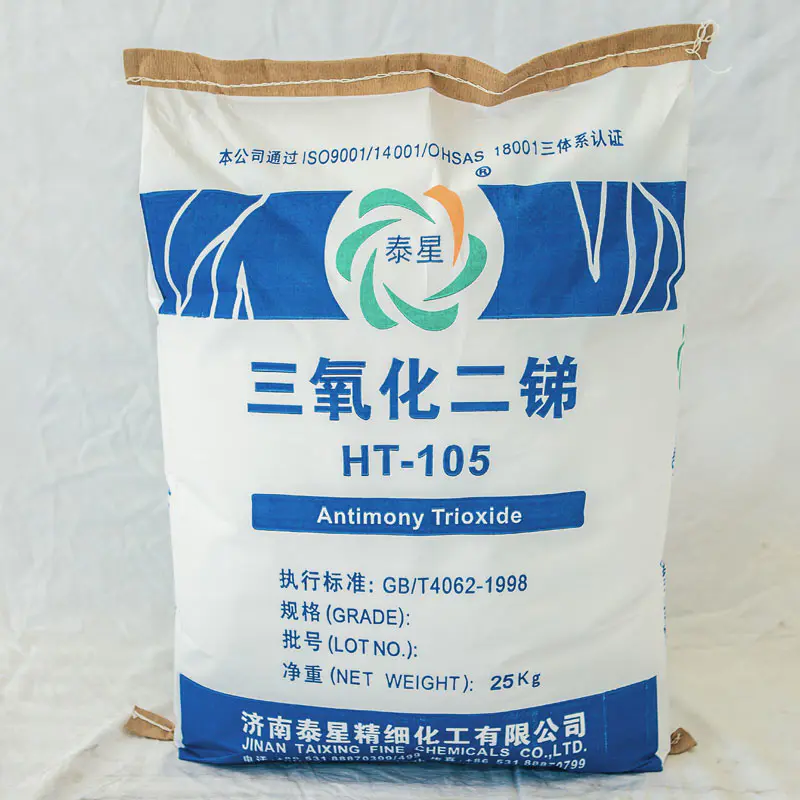
Antimony Trioxide


II. Chemical mechanism of halogen antimony synergy: a precise "three-stage rocket" reaction program

The combination of the two is not simply a superposition, but triggers a series of continuous and autocatalytic chemical reactions, with the core goal of generating high concentrations of active antimony halide free radical scavengers in situ in the flame zone.

Phase 1: Generation of Active Precursors (Role of Halogens)

When polymers are heated, halogenated flame retardants (commonly represented by R-X, where X is Cl or Br) first decompose, releasing hydrogen halides.

R-X → Cracking products+HX (g) (HX=HCl or HBr)

HX is the "fuel" and "transporter" for all subsequent reactions, transporting halogen atoms in an active form to the surface of Sb₂O₃ and initiating a chain reaction.


Phase 2: Synthesis of active intermediates (activation of Sb₂O₃)

The released HX gas undergoes gas-solid phase reaction with the surface of solid Sb₂O₃ particles. This is the crucial first step in activation:

Sb ₂ O ∝ (s)+6HX (g) → 2SbX ∝ (g)+3H ₂ O (g) (temperature>250 ℃)

This reaction generates volatile antimony trihalide, which allows antimony to enter the gas phase from the solid phase and gain the ability to freely diffuse and participate in the reaction in the flame.


Phase 3: Gas phase free radical capture cycle (efficiency enhancing core)

The generated SbX ∝ enters the high-temperature flame zone (>800 ℃), which is filled with high-energy free radicals H · and · OH that maintain the combustion chain reaction. SbX ∝ captures and neutralizes these free radicals through an efficient catalytic cycle:

Main capture path (taking H · as an example):

SbX ∝ (g)+H ·→ HX (g)+SbX ₂· (g) (Step 1: Capture an H ·)

SbX ₂ · (g)+H ·→ HX (g)+SbX · (g) (Step 2: Capture the second H ·)

SbX · (g)+H · → HX (g)+Sb (s or g) (Step 3: Capture the third H ·)

Completion of catalytic cycle:

The generated HX can react with Sb₂O₃ again to generate SbX ∝, and antimony species (Sb, SbX ·) will quickly combine with halogen free radicals (X ·) in a halogen rich flame to regenerate SbX ∝, forming an efficient closed loop:

Sb + 3X· → SbX₃

Net effect: In this cycle, SbX ∝ acts as a "free radical transporter", converting high-energy H · and · OH free radicals into much less chemically active HX molecules and water, thereby sharply reducing the reaction rate and temperature of the flame and achieving efficient chemical extinguishing.


III. The efficiency difference between bromine and chlorine: a ruling of chemical kinetics

The synergistic efficiency of the bromine antimony system is much higher than that of the chlorine antimony system, and the fundamental reason is the advantage of reaction kinetics determined by chemical bond energy:

parameter Bromine antimony system Chlorine antimony system The impact on collaborative efficiency
C-X bond energy ~68 kcal/mol (C-Br) ~81 kcal/mol (C-Cl) Bromine is more prone to decomposition and releases HBr at lower temperatures, which matches better with polymer decomposition.
H-X bond energy ~88 kcal/mol (H-Br) ~103 kcal/mol (H-Cl) HBr is more prone to uniform cracking and provides a faster reaction rate between halogen free radicals (Br ·) and antimony species in the gas phase.
reactivity tall medium-low The generation and free radical capture cycle of SbBr VNet are faster and more efficient than SbCl VNet.


Therefore, in practical applications, to achieve the same flame retardant level (such as UL94 V-0), the total addition amount of bromine antimony system is usually 20% -40% lower than that of chlorine antimony system, and the proportion of Sb₂O₃ used is relatively lower.


IV. Conclusion: A precise 'chemical strategy' rather than a simple formula

Antimony trioxide must be used in conjunction with halogens, and its essence is to design a precise chemical reaction pathway to dynamically, continuously, and efficiently convert the "halogen reserve" provided by halogen flame retardants into gas-phase free radical scavengers through the catalytic mediation of antimony.

·The function of halogens is to provide reaction materials (HX) and maintain the circulation of halogen free radicals (X ·).

·The function of antimony trioxide is to provide reaction centers (antimony atoms), construct and drive an automatic catalytic cycle of "generation capture regeneration".

This cooperative relationship is an outstanding example of humans using chemical principles to control combustion. However, with the deepening of material environmental protection and fire safety lifecycle assessment, this classic system also faces challenges due to the potential environmental and health risks of antimony. Understanding the necessity and chemical essence of its coordination is not only for the more scientific application of it, but also for the rational evaluation of its alternative technologies (such as phosphorus nitrogen expansion systems, metal hydroxy salts, etc.), promoting the evolution of flame retardant technology towards a more efficient and cleaner future.Are you seeking efficiency optimization or exploring environmentally friendly alternative paths in your antimony halide flame retardant formula? We can provide TGA-FTIR testing and formulation simulation services based on reaction kinetics analysis to clarify the synergistic mechanism and find the optimal balance between performance and sustainability.


Related News
Leave me a message
X
We use cookies to offer you a better browsing experience, analyze site traffic and personalize content. By using this site, you agree to our use of cookies. Privacy Policy
RejectAccept