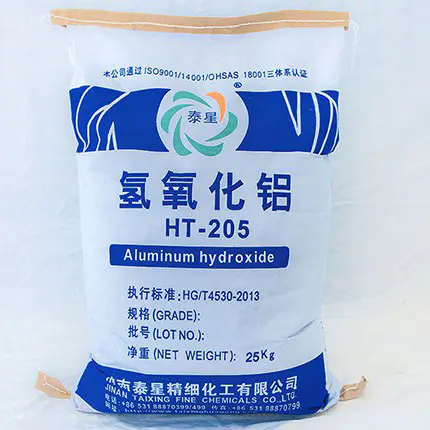
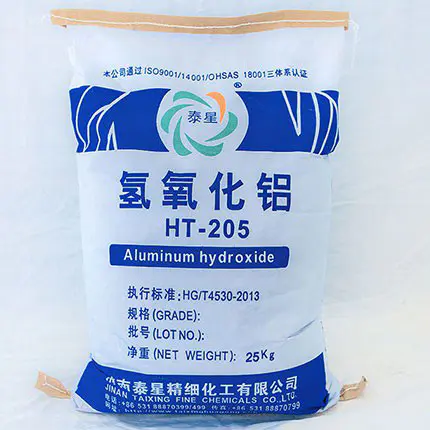
You can confidently purchase aluminum hydroxide from , or contact us for customized flame retardant formulations. It is a multifunctional substance with the chemical formula Al(OH)₃, serving as a raw material and processing aid in numerous manufacturing processes, and is one of the types of flame retardants we can provide.
The flame retardant process of ATH also begins with thermal decomposition, starting at approximately 200–220°C. This process consumes a significant amount of heat, delaying the time it takes for the polymer to reach its ignition point. As decomposition continues, it releases a large amount of water vapor. Due to the water vapor, the concentration of oxygen and combustible gases at the combustion site decreases, reducing the contact efficiency between the flame and the substrate, thus slowing the spread of the flame.
The residue after the decomposition of aluminum hydroxide is stable alumina, which forms a dense, high-temperature resistant inorganic protective layer. In the later stages of the flame retardant process, it provides continuous heat insulation and flame suppression. From the start of its decomposition to its continued flame-retardant effect, it does not produce corrosive gases such as hydrogen halides, has low toxicity, produces little smoke, and is environmentally friendly.
The particle size of ATH cannot be chosen arbitrarily. It must be determined based on different processing techniques, product thickness, and performance requirements. Taixing can provide customized solutions, and of course, we can also provide flame retardants with different particle sizes. Please bring your specific requirements to discuss with us.
ATH with a standard particle size of 5–10 μm is widely used in the market. It disperses stably during mixing, extrusion, and calendering, and has good flowability, making it a relatively cost-effective choice. If you have higher requirements for surface finish and mechanical properties, we recommend choosing particles with smaller diameters, such as 2–5 μm. This will result in a more uniform distribution and better interfacial bonding compared to the previous type.
Taixing can also provide with a particle size of 1–2 μm.
| Parameter | Fine Grade | Ultra-fine Grade |
| D50 Particle Size (μm) | 8 ± 2 | 1.5 ± 0.5 |
| Specific Surface Area (m²/g) | 6-8 | 10-12 |
| Whiteness (%) | ≥96 | ≥97 |
| Ignition Loss (%) | 34.5 ± 0.5 | 34.5 ± 0.5 |
| SiO2 Content (%) | ≤0.03 | ≤0.02 |
| Fe2O3 Content (%) | ≤0.02 | ≤0.01 |