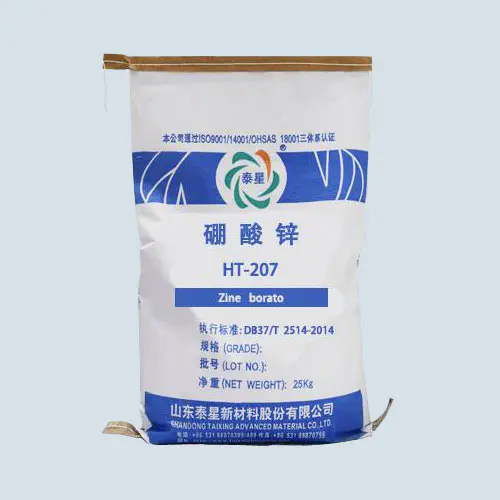
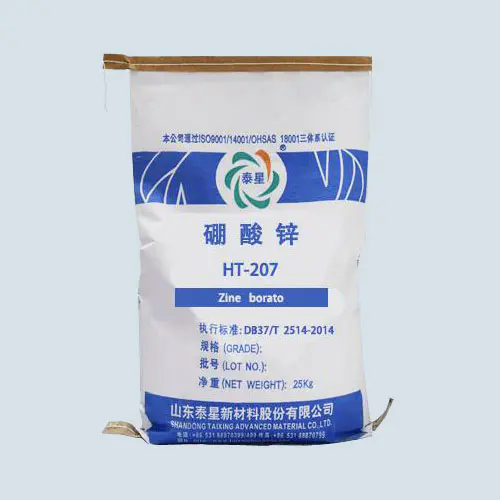
In the complex formulation system of polyvinyl chloride (PVC) cable materials, the addition amount of zinc borate (mainly 2ZnO·3B₂O₃·3.5H₂O) is not an isolated empirical value, but a system optimization result determined by the synergistic smoke suppression chemistry of "chlorine zinc boron", the performance goals of the final product, and the comprehensive cost-effectiveness. This article will start from the intrinsic flame retardant properties of PVC, deeply analyze the unique mechanism of zinc borate in its system, and construct a scientific decision-making logic for addition amount.
PVC itself is a polymer with intrinsic flame retardancy (chlorine content~56.7%), and its flame retardant mechanism mainly relies on the interrupted chain reaction of chlorine free radicals in the gas phase. However, PVC has two major pain points during combustion:
1. Massive smoke emission: Incomplete combustion produces a large amount of carbon particles (thick black smoke).
2. Release corrosive and toxic hydrogen chloride (HCl) gas.
Therefore, in PVC cable materials (especially low smoke halogen-free type, LSZH-FR), the core goal of additives has shifted from "improving flame retardancy" to "efficient smoke suppression, reducing HCl release, and improving the quality of combustion residues". Zinc borate is a "functional synergist" designed to address these pain points.
The efficacy of zinc borate in PVC is determined by its chemical reaction with the pyrolysis products of PVC, which determines its effective concentration range.
Core chemical reaction - "chlorine zinc boron" ternary synergy:
PVC decomposes and releases HCl when heated. HCl reacts with zinc borate to produce zinc chloride (ZnCl ₂) and boron oxychloride.
2ZnO·3B₂O₃·3.5H₂O + 22HCl → 2ZnCl₂ + 6BCl₃ + 14.5H₂O
(Subsequently, ZnCl ₂ and BCl₃ will be further converted into oxygen-containing chlorine compounds under high temperature and water vapor conditions)
·The catalytic carbonization effect of ZnCl ₂: The generated ZnCl ₂ is a strong Lewis acid catalyst. It can strongly catalyze the cross-linking, cyclization, and aromatization reactions of the polyene structure formed after HCl removal in PVC, promoting the formation of earlier, denser, and higher strength expanded carbon layers. A dense carbon layer can:
1. Physically block the transfer of heat and mass.
2. Efficiently capturing soot particles and fixing them in the condensed phase is the key to achieving smoke suppression.
·The glass barrier effect of boron species: The boron oxychloride formed during the reaction melts at high temperatures, forming a glassy protective layer covering the surface of the carbon layer, further stabilizing the carbon layer, isolating oxygen, and promoting the oxidation of organic matter on the surface of the carbon layer (reducing black smoke).
Therefore, the amount of zinc borate added must be sufficient to ensure sufficient reaction with the HCl released by PVC, generating a sufficient amount of ZnCl ₂ to construct an effective catalytic char network.
In traditional antimony containing PVC flame-retardant cable materials, zinc borate is often used as a partial substitute or enhancer.
·Character Evolution:
·Complete substitution: In environmentally friendly formulas that require complete "antimony free", zinc borate can be used alone as a smoke suppressant synergist.
·Partial substitution (mainstream trend): In order to balance performance and cost, and respond to antimony reduction requirements, zinc borate is commonly used to replace 20% -50% of Sb₂O₃. For example, if the original formula used 4 phr Sb₂O₃, it can be adjusted to 2 phr Sb₂O₃+1.5-3 phr zinc borate.
·Collaborative logic: Sb₂O₃ mainly improves the gas-phase flame retardant efficiency, while zinc borate strengthens the condensed phase to suppress smoke and char formation. The combination of the two achieves a "three-dimensional fire prevention" between the gas phase and the condensed phase.
This is the core driving factor that determines the amount of addition.
·Standard flame-retardant and smoke suppressing cable material:
·Objective: To meet flame retardant standards such as UL 1581 VW-1/IEC 60332 and have good smoke suppression.
·Typical addition range: 1-3 phr (parts per hundred parts of PVC resin).
·Low smoke halogen-free (LSZH) or cable materials with strict smoke suppression requirements:
·Objective: To meet low smoke standards such as IEC 61034/EN 50268-2, or strict requirements in places such as subways, ships (such as EN 45545-2), nuclear power plants, etc.
·Typical addition range: 3-8 phr. The high addition amount aims to build an extremely powerful catalytic carbonization and vitrification barrier system, ensuring that the smoke transmittance meets the standard in forced ventilation or tunnel fire scenarios.
·High filling calcium zinc stabilizer system:
·When using a large amount of fillers such as calcium carbonate (CaCO₃), it is necessary to increase the amount of zinc borate added appropriately (such as 2-5 phr) to compensate for the "dilution effect" of fillers on flame retardancy and smoke suppression.
·Compound with aluminum hydroxide (ATH): In halogen-free formulations, ATH is the main filler. Zinc borate (2-5 phr) can form a temperature synergy with the dehydration endothermic effect of ATH, exerting smoke suppression effects over a wider temperature range.
·Compound with molybdenum compounds: Calcium molybdate/zinc molybdate is a top-level smoke suppressant. Zinc borate can be compounded with it at a lower cost (such as a ratio of 1:0.5-1) to achieve synergistic efficiency.
The addition of zinc borate is not necessarily better, and a balance point needs to be found in the following "performance triangle":
1. Positive effect (enhanced with increasing dosage):
·Smoke suppression performance (significant decrease in smoke density)
·Improvement of residual carbon strength and quality
·A certain degree of flame retardant synergistic effect (oxygen index may slightly increase)
2. Negative effect (manifested when added excessively):
·Reduced processing fluidity: Zinc borate is an inorganic powder, and excessive addition can increase melt viscosity, affecting extrusion speed and surface smoothness.
·Loss of mechanical properties: Overfilling may lead to a decrease in tensile strength, especially elongation at break.
·Electrical performance impact: Trace metal ions may have a potential impact on volume resistivity and should be carefully evaluated for high-voltage cable materials.
·Cost increase.
Therefore, the "optimal addition amount" is the point that has the least comprehensive impact on processability, mechanical properties, and cost while meeting the target smoke suppression and flame retardant levels.
It is recommended to use the following steps to determine the optimal addition amount in the specific formula:
1. Benchmark determination: Clarify the final application standards of cable materials (flame retardant level, smoke density level, usage environment).
2. Starting point design:
·For general flame retardant and smoke suppressant materials: starting from 1.5 phr.
·For LSZH material: starting from 3.5 phr.
·If replacing Sb₂O₃: use 30% of Sb₂O₃ mass as the starting point for zinc borate.
3. Experimental design: Using the starting point as the median, design an addition gradient (such as ± 1.5 phr) to prepare a series of samples.
4. Key performance testing:
·Core functions: Smoke density testing (NBS box), oxygen index, vertical combustion.
·Comprehensive performance: tensile strength and elongation, melt flow rate (or capillary rheology), volume resistivity.
5. Data analysis and determination: Draw a performance addition curve graph. Find the "inflection point area" where the smoke suppression performance reaches the target platform area, but the processing and mechanical properties have not yet sharply decreased, and this area is the optimal range of addition amount.
The amount of zinc borate added in PVC cable material is a typical performance oriented variable. A simple number (such as 3 phr) cannot be applied to all scenarios.
The scientific decision-making logic is:
1. Mechanism driven: Ensure that the amount added is sufficient to initiate an effective "chlorine zinc boron" catalytic char reaction.
2. Standard driven: Determine the bottom line of demand based on the strictness of the smoke suppression and flame retardant standards that the final product must pass.
3. Collaborative drive: In the complex system (with Sb₂O₃, ATH, etc.), the synergistic effect of "1+1>2" can be achieved by optimizing the ratio, which may reduce the total dosage.
4. Balanced drive: On the premise of meeting the functional requirements, find the optimal economic point through experiments that minimizes the impact on processing and application performance.
Therefore, for cable material formulation engineers, the true professional ability does not lie in remembering a universal ratio, but in mastering the above system methods, being able to tailor calculate the optimal zinc borate addition scheme for each specific PVC cable material product, balancing its performance, cost, and regulatory requirements.
Are you developing or optimizing low smoke and halogen-free formulations for specific PVC cable materials such as data cables, power cables, and marine cables? We can provide formula design support, key performance testing, and optimal addition optimization services based on zinc borate synergistic chemistry to help you meet your specific needs accurately and enhance product competitiveness.