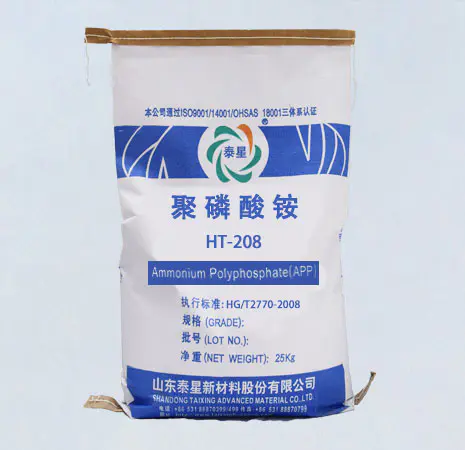
The persistent issues of blistering, peeling, surface "salt precipitation," and drastic decline in fire resistance of intumescent coatings in humid or outdoor environments have long plagued both contractors and property owners. The root cause often directly points to the core component of the system—ammonium polyphosphate (APP). Due to its inherent hydrophilicity and hydrolysis tendency, traditional APP has become the "weak link" in the water resistance of coatings. This paper will delve into the molecular-level mechanisms by which APP leads to poor water resistance and systematically elucidate how scientifically selecting high-polymerization APP and microencapsulated APP can fundamentally restructure the water resistance barrier of intumescent coatings.
Ammonium polyphosphate (NH₄PO₃)ₙ is an indispensable acid and gas source in intumescent fireproof coatings. Its failure mechanism is a coupled physical and chemical chain reaction:
· Hydrolysis process: In a humid environment, water molecules attack the P-O-P bonds in the APP molecular chain, and the hydrolysis reaction is catalyzed and accelerated under acidic or alkaline conditions. The process can be simplified as follows:
(NH₄PO₃)ₙ + H₂O → (NH₄PO₃)ₙ₋₁ + NH₄H₂PO₄
The long-chain APP gradually degrades into short-chain polyphosphate ammonium and the final product, ammonium phosphate.
· Catastrophic consequences:
Loss of carbonization catalytic capability: The ability of APP to catalyze the dehydration of polyols into carbon at high temperatures is directly proportional to its degree of polymerization (n-value). Low-polymerization APP exhibits poor thermal stability and low catalytic efficiency, resulting in a loose and weak expanded carbon layer that fails to provide an effective thermal insulation barrier.
· Early depletion of gas source: During the hydrolysis process, ammonium ions (NH₄⁺) escape as ammonia gas, resulting in insufficient gas volume required for foaming expansion during a fire, leading to a reduced expansion ratio.
Hydrophilicity and Deliquescence: The abundant polar ammonium salts and phosphate groups in APP molecules confer strong hydrophilicity, enabling them to readily absorb moisture from the environment. Upon absorbing moisture, the material expands in volume, compromising the cohesive strength of the coating.
Ion leaching and salt precipitation: The water-soluble ammonium phosphate salts produced by hydrolysis migrate to the coating surface and crystallize as white powdery "efflorescence" during water evaporation. This not only damages aesthetics but also leaves pores in the coating, creating pathways for moisture and corrosive agents to penetrate deeply, leading to permanent loss of effective flame-retardant components.
Electrochemical corrosion induction: Leached ions form an electrolyte on the steel surface, directly accelerating the corrosion of the base metal. The volume expansion of corrosion products can further lift the coating, leading to early delamination.
Enhancing the intrinsic chemical stability of the APP is a fundamental strategy. The degree of polymerization (n) serves as the core metric for evaluating its performance.
· Grading and Significance of Aggregation Degree:
· Low-degree polymerization APP: n < 100. Highly water-soluble, poor thermal stability, mainly used in agriculture and forestry, etc.
· Medium Aggregation Degree APP: n ≈ 500-1000. Traditionally selected for fireproof coatings, but still insufficient water resistance.
· High-polymerization APP (Type II APP): n > 1000, typically reaching 1500-2000 or even higher. Its long-chain molecular structure brings about qualitative changes:
1. Significant improvement in hydrolytic stability: The abundance of P-O-P bonds ensures minimal impact on overall molecular weight even with minor chain scission. Its higher crystallinity and denser molecular chain packing effectively block water molecule attacks.
2. Excellent thermal stability: The decomposition temperature is higher (>270°C), better matching the decomposition temperature window of the char-forming agent, enabling continuous and stable catalytic char formation and resulting in a denser and more robust expanded carbon layer.
3. Significant reduction in hygroscopicity: The proportion of hydrophilic terminal groups (NH₄⁺) per unit mass is lower, resulting in both the initial hygroscopic rate and equilibrium moisture absorption being much lower than those of low-polymerization products.
· How to Choose High Aggregation Apps? Key Metrics Analysis:
1. Degree of polymerization (n) and viscosity: Directly require suppliers to provide viscosity data for 1% aqueous solutions (typically >30 mPa·s). Viscosity is the most reliable industrial indicator for indirectly reflecting the degree of polymerization, with high viscosity indicating high molecular weight.
2. Crystalline morphology: Prefer Type II crystals (long-chain structure), which exhibit superior thermal stability and water resistance compared to Type I (branching structure).
3. Phosphorus (P) and Nitrogen (N) Content: High polymerization APP typically requires P₂O₅ content > 68% and N content > 14%, which serves as the chemical foundation for efficient catalysis and foaming.
4. Water solubility: The solubility at room temperature in water must be <1.5 g/100ml. This directly reflects its water resistance.
High-aggregate APP enhances "internal strength," but when facing prolonged harsh humid-heat environments, stronger physical isolation is still required. Microencapsulation technology achieves a revolutionary breakthrough by equipping APP particles with a "hydrophobic armor.".
· Core Technical Mechanism:
Using melamine-formaldehyde resin (MF), epoxy resin, polyurethane, or silicone resin as the shell material, a continuous, dense, and chemically cross-linked hydrophobic polymer film is formed on the surface of APP particles through in-situ polymerization.
· Core dimensions for microencapsulation APP selection:
Shell material and structure:
· MF resin shell layer: The most mainstream option, featuring high hardness, excellent heat resistance, and strong barrier properties. When selecting, focus on the prepolymer synthesis process and crosslinking density, as higher crosslinking density indicates lower shell permeability.
· Silicone/epoxy modified shell: Superior flexibility, hydrophobicity, and weather resistance, suitable for applications requiring high coating flexibility or extreme climatic conditions.
2. Coating Rate and Integrity:
· The required coating rate must exceed 95%. The surface should be observed via scanning electron microscopy (SEM) to ensure it is smooth, continuous, and free of exposed APP cores.
·Thermogravimetric analysis (TGA) can assist in determining that there should be no significant weight loss (shell stability) of microencapsulated products before the decomposition temperature of APP, while traditional APP will lose weight due to moisture absorption.
3. Key indicators of water resistance:
·24-hour water absorption rate: should be less than 1.5%.
·Boiling water resistance: After boiling in boiling water for 1-2 hours, observe whether the particles disintegrate, and measure the phosphorus content of the filtrate to quantify its anti extraction ability.
·Performance retention rate after long-term wet heat aging: Place the sample in an 85 ° C/85% RH environment for hundreds of hours to test its phosphorus content retention rate and thermal analysis curve for differences with fresh samples.
4. Synergy with coatings:
·The shell material should have good compatibility with the coating resin base material (such as acrylic acid, epoxy) to ensure uniform dispersion in the coating and prevent interface defects.
To overcome the challenge of water resistance in fire-retardant coatings, it is essential to scientifically re-engineer the APP (Ammonium Polyphosphate) at its source. High-polymerization-degree APP establishes a fundamental defense against hydrolysis by enhancing the chemical stability of the molecular chains themselves, whereas microencapsulated APP provides ultimate protection against liquid water erosion by creating a physical barrier.