Although the halogen antimony synergistic flame retardant system has dominated the market for decades, the environmental regulatory pressure, toxicity disputes, and negative impact on material properties it faces are driving global flame retardant science to innovate towards cleaner and more efficient directions. The substitution of antimony halide system is not a simple substitution of a single material, but a systematic technological revolution based on new flame retardant chemistry, nanotechnology, and bio based materials. This article will systematically analyze the scientific principles, application progress, and future challenges of the three emerging technology paths.
1. Regulation and environmental pressure: The EU REACH regulation lists antimony trioxide as a highly concerned substance (SVHC), and some varieties of brominated flame retardants are regulated by the Stockholm Convention. Global "halogen-free" and "antimony free" have become mandatory trends in fields such as electronics and rail transportation.
2. New understanding of fire safety: The halogen antimony system is highly efficient in gas-phase fire extinguishing, but it can produce a large amount of corrosive and toxic smoke (HX, antimony compounds), endangering personnel evacuation and rescue. Modern flame retardant standards (such as EN 45545, GB 20286) increasingly emphasize low smoke, low toxicity, and non corrosiveness.
3. Comprehensive demand for performance and cost: We need to find new solutions that do not affect the mechanical, electrical, and optical properties of materials and can adapt to high-temperature processing.
This path aims to construct a more efficient and environmentally friendly "gas-phase condensed phase" dual flame retardant network to replace the gas-phase dominant mechanism of antimony halides.
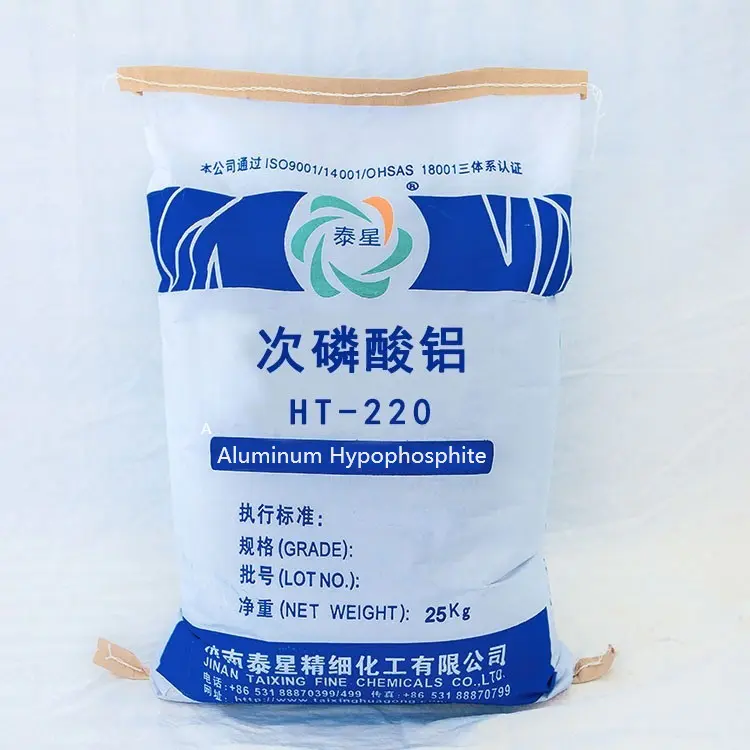
·Representative: Aluminum Hypophosphate (AHP) and Its Supramolecular Modifications.
·Mechanism advancement: Traditional AHP has been applied to engineering plastics, and emerging technologies have been developed through:
·Microencapsulation: Encapsulating AHP with thermosetting resin (such as melamine formaldehyde resin) significantly improves its water resistance, compatibility with polymers, and thermal stability, solving the problems of moisture absorption and processing decomposition.
·Organic inorganic hybridization: AHP is combined with nitrogen-containing organic cations (such as melamine and guanidine salts) through ionic bonds to form molecular level dispersed P-N synergistic units, achieving more precise and synchronized gas-phase (PO · free radicals) and condensed phase (catalytic carbonization) synergy during decomposition.
·Application: In PA and PBT, microencapsulated AHP can reduce the dosage by 15% compared to traditional AHP and achieve the same V-0 level, with a higher retention rate of mechanical properties.
·Representative: DOPO (9,10-dihydro-9-oxa-10-phosphaphenanthrene-10-oxide) derivatives, phosphazene compounds.
·Mechanism breakthrough:
·Reactive design: The DOPO group is chemically bonded to the main or side chains of epoxy resin, polyester, or polyurethane to achieve permanent bonding of flame retardant elements, fundamentally solving the problem of precipitation and migration of small molecule flame retardants and endowing the material with intrinsic flame retardancy.
·Structural designability: Through molecular design, its decomposition temperature, gas-phase activity, and carbonization ability can be precisely controlled. For example, combining DOPO with triazine ring can simultaneously release phosphorus containing free radicals during combustion (gas-phase quenching) and form a nitrogen rich expanded carbon layer (condensed phase barrier).
·Application: It has become a standard halogen-free solution for high-end epoxy electronic packaging materials and polyester fibers.
This pathway significantly improves the efficiency of traditional inorganic flame retardants through nanotechnology, morphology control, and synergistic compounding, filling the gap of their high dosage.
·Mechanism: LDH is an anionic layered clay with the general formula [M ² ⁺₁₋ₓ M ³ ⁺ₓ (OH) ₂] ᵡ⁺ (A ⁿ⁻) ₓ/ₙ· mH ₂ O. When heated, the interlayer releases water vapor (cooling, dilution), and the interlayer anions (such as CO₃²⁻) decompose to produce CO ₂. At the same time, the interlayer converts into porous metal oxides, adsorbs toxic smoke, and catalyzes the polymerization of polymers. Charcoal.
·Advantages: It integrates flame retardancy, smoke suppression, anti melt droplet, and thermal stability. By regulating the metal ions (Mg/Al, Zn/Al, etc.) and interlayer anions of the laminated board, its function can be customized.
·Challenge and breakthrough: Traditional LDH is difficult to disperse in polymers. Emerging technologies have achieved nanoscale exfoliation and dispersion of materials in the matrix through organic modification (such as sodium dodecyl sulfate intercalation) and in-situ growth methods. The comprehensive fire safety performance of materials can be significantly improved with extremely low addition amounts (3-5%).
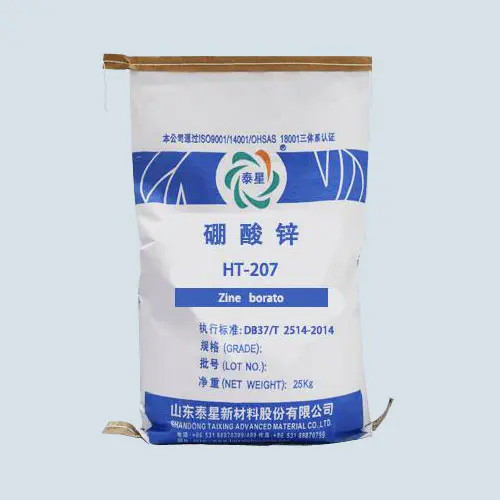
·Emerging direction: Traditional zinc borate (ZB) as a synergistic agent. The current research and development focus is on:
·Nano hollow spherical zinc borate: greatly increases the specific surface area, enhances smoke suppression and catalytic carbonization efficiency.
·Surface grafting of polymer chains: creating a "toughening like" effect with specific polymers (such as TPU), improving mechanical properties while flame retardant.
·Representative: Zinc Stannate (ZS), Zinc Hydroxystannate (ZHS).
·Mechanism: Its mode of action is similar to that of Sb₂O₃, and it can produce certain synergy with halogens (tin halogen synergy), but the key advantage is that it promotes the formation of a denser and earlier formed carbon layer during combustion, and its smoke suppression effect is significantly better than that of Sb₂O₃, with extremely low toxicity.
·Application: In PVC cable materials and some engineering plastics, a 1:1 substitution of Sb₂O₃ has been successfully achieved, and it exhibits better smoke suppression and transparency.
·Sources: Phytic acid (from grains), lignin, chitosan (from shrimp and crab shells), DNA, etc.
·Mechanism and advantages: These natural molecules are rich in flame retardant elements such as phosphorus, nitrogen, and carbon. For example, phytic acid molecules contain six phosphate groups, with a phosphorus content of up to 28%, making them an efficient and non-toxic bio based acid source. By chemically modifying it and grafting it onto polymer chains, it can exhibit excellent catalytic char formation.
·Challenge: Thermal stability, compatibility with synthetic polymers, and cost are currently the main bottlenecks.
·Representatives: Graphene, Carbon nanotubes (CNT), MXene.
·Mechanism:
·Excellent physical barrier: Two dimensional graphene or MXene layers form a "maze effect" in the polymer, effectively delaying the escape of combustible gases and heat transfer.
·Catalytic carbonization network: These materials have high thermal conductivity and catalytic activity, which can promote the rapid formation of continuous and high-strength graphitized carbon layers at the combustion interface of polymers.
·Application mode: Usually used as a "synergist in synergists", it can be compounded with the above-mentioned phosphorus nitrogen or metal hydroxide system at a very low addition amount (0.5-2%), which can significantly reduce the amount of main flame retardant and improve the quality of the carbon layer. For example, the "aluminum hypophosphite+surface modified graphene" system exhibits excellent synergistic effects of "1+1>2".
The emerging technology to replace the halogen antimony system is not about finding a "functional equivalent", but about driving a fundamental shift in the paradigm of flame retardant science: from relying on a single, highly toxic, gas-phase interrupted chemical strategy, to a systematic material design based on multi-element synergy, multifunctional integration, precise regulation of nanostructures, and environmental friendliness.
The future winners will be those who can:
1. Design materials at the molecular level to achieve the unity of intrinsic flame retardancy and high performance.
2. Cross border integration technology, deeply combining nanotechnology, surface science, and combustion chemistry.
3. Possess a full lifecycle mindset, comprehensively evaluating its sustainability from raw material sources, production processes to fire safety and final recycling.
For material manufacturers, actively embracing these emerging technologies is not only for compliance, but also to gain strategic advantages in the competition of next-generation high-performance and sustainable materials.Does your product face specific challenges in replacing halogenated antimony systems? Whether seeking short-term compliance solutions or planning long-term technology roadmaps, our R&D team can provide you with a full chain solution from technical evaluation, formula development to mass production support.