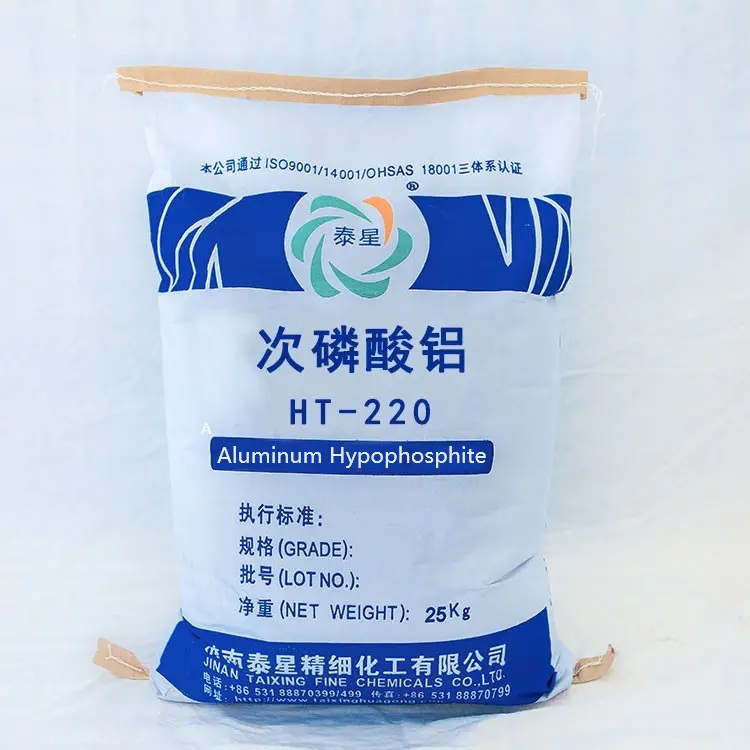
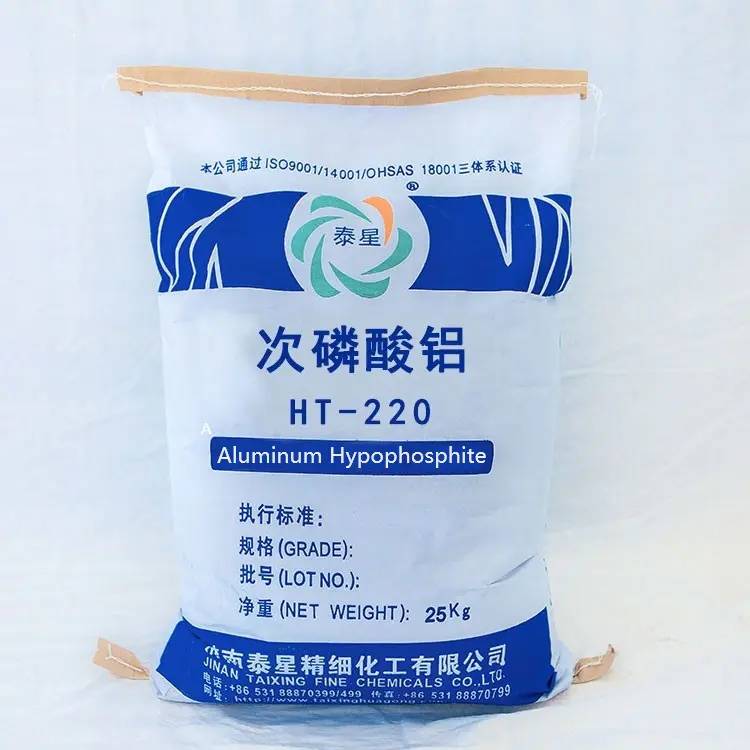
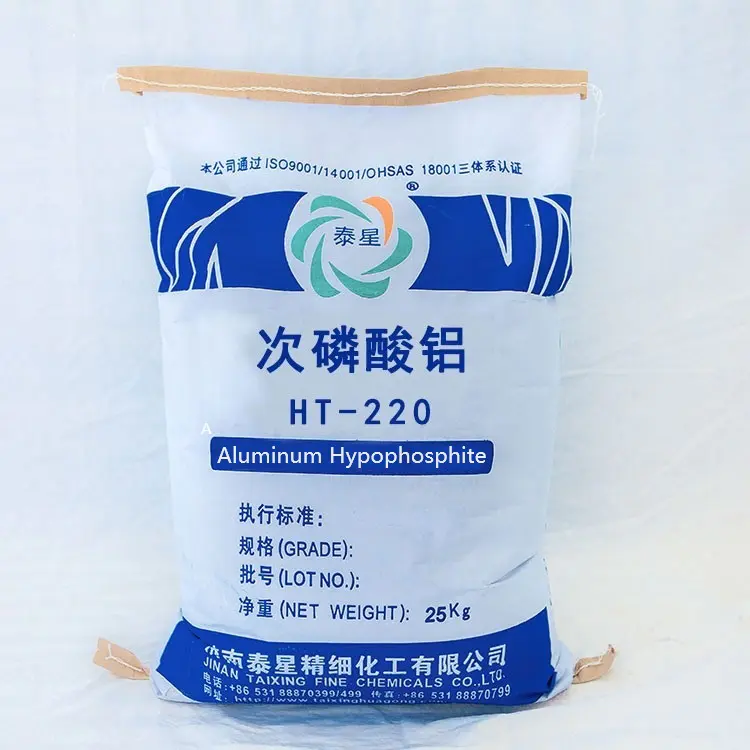
Aluminum hypophosphite, with the chemical formula Al(H₂PO₂)₃, is a white crystalline powder. It is also a highly effective flame retardant in the polymer field. Taixing welcomes you to contact us to purchase this type of product. Through a condensed phase mechanism, it promotes char formation and reduces the release of combustible gases during thermal decomposition. Its high phosphorus content is a key factor in its high flame retardancy.
Aluminum hypophosphite can be used in a variety of polymer composites, including polyamides, polyesters, epoxy resins, and polyurethanes. We can customize formulations to meet your specific processing needs and desired flame retardant system.
In electronic and cable applications, including but not limited to insulation materials, circuit board laminates, and cable sheaths, it helps meet the UL 94 V-0 safety standard and is also a good flame retardant choice.
Other areas such as textiles and coatings, and it is commonly used in interior decoration, curtains, and the backing coating of protective clothing. If you have any other questions that you would like to confirm regarding the suitability of using aluminum hypophosphite, please feel free to contact us.
For the addition and storage processes, please use it as soon as possible after opening, and make sure your operators wear protective equipment to prevent dust from harming the human body. The processing area should also be well ventilated. Unused products should be kept away from strong oxidants and other incompatible substances, and please do not put them in environments with prolonged high temperature and humidity. They should be stored in a cool, dry, and well-ventilated place.
Yes, and we can provide synergistic flame retardant formulations. The specific combination depends on the type of flame retardant and the material system used.
For example, when mixed with (ATH), both are halogen-free flame retardants. ATH decomposes endothermally and releases water vapor to lower the ignition source temperature, while AP releases acidic substances through phosphate ions to promote charring and expansion. We will provide a suitable combination scheme based on the specific circumstances.
It can also be considered for mixing with , where the effects are complementary.
When combined with brominated flame retardants, in addition to improved flame retardant performance, the overall halogen content can be reduced, resulting in improved environmental friendliness.