Shandong Taixing Advanced Material Co., Ltd.
News

Why Is 3.5 Hydrated Zinc Borate Commonly Used as a Flame Retardant in PVC Cables?

2026-05-12 0 Leave me a message

Polyvinyl chloride (PVC) is the dominant choice for cable insulation and sheath materials, and its flame retardant properties are directly related to the safe operation of the power system. Among numerous flame retardants, 3.5 hydrated zinc borate (2ZnO·3B₂O₃·3.5H₂O) has become a key component in PVC cable formulations. This article will systematically analyze the scientific basis behind this choice.


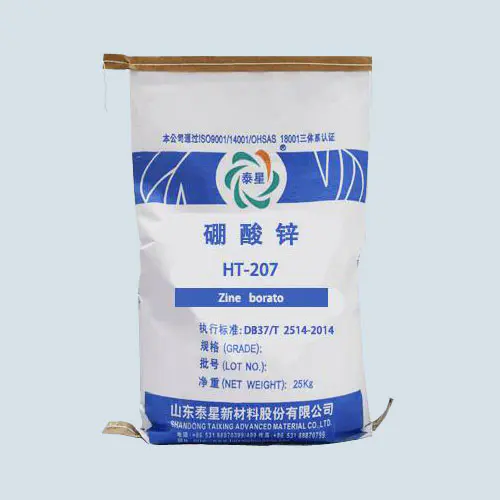
Zinc Borate


I. Chemical basis of flame retardant mechanism: multi-mode synergistic effect

1.1 Dehydration and heat absorption process in the thermal decomposition stage

The crystal water content of 3.5% hydrated zinc borate (about 14.5%) has been precisely designed to achieve an ideal match between its thermal decomposition temperature and the initial decomposition temperature of PVC (about 200-300°C). When the cable encounters a fire source, zinc borate releases crystalline water in the temperature range of 210-320°C

Zn₂B₆O₁₁·3.5H₂O → Zn₂B₆O₁₁ + 3.5H₂O↑

This process absorbs a large amount of heat (dehydration enthalpy of about 280 J/g), effectively reducing the surface temperature of the material and delaying the thermal degradation rate of the PVC resin matrix. Compared to higher hydration forms such as 5-hydrate and 7-hydrate, the dehydration temperature window of 3.5 hydrate is more precise, avoiding protection blind spots caused by premature dehydration or delayed dehydration.

1.2 Formation mechanism of glassy protective layer

Dehydrated anhydrous zinc borate (Zn₂B₆O₁₁) melts at 400-500°C and reacts with hydrogen chloride (HCl) produced by PVC decomposition:

Zn₂B₆O₁₁ + 12HCl → 2ZnCl₂ + 6BCl₃ + 6H₂O

The generated ZnCl₂ and BCl₃ act as Lewis acid catalysts to promote the crosslinking reaction of PVC, forming an expanded carbon layer. At the same time, boron oxide is converted into viscous B₂O₃ glass at temperatures above 700°C

2BCl₃ + 3H₂O → B₂O₃ + 6HCl

The glass body covers the surface of the carbon layer, forming a dense protective barrier. Its dynamic viscosity (10³-10⁴ Pa·s) can effectively block oxygen permeation and heat transfer at flame temperature.


Ⅱ. Unique compatibility and synergistic effect with PVC system

2.1 Optimization of Acid Capture Agent Function

The HCl released from PVC pyrolysis not only accelerates material degradation, but also produces corrosive and toxic smoke. Zinc borate efficiently captures HCl through a two-step reaction:

1. Primary capture: Surface hydroxyl groups react with HCl to generate ZnCl ₂ and boric acid

2. Secondary capture: The generated boric acid further reacts with HCl to form BCl₃

Each mole of 3.5 hydrated zinc borate can theoretically consume 12 mol of HCl, with a capture capacity of 43.7%. Compared to traditional flame retardants such as aluminum hydroxide (only 33%), its unit mass acid neutralization efficiency is increased by 32%.

2.2 Synergistic Enhancement with Antimony Trioxide

In the formulation of PVC cables, zinc borate exhibits a significant synergistic effect with Sb₂O₃:

Zn₂B₆O₁₁ + Sb₂O₃ + HCl → ZnSb₂O₅+borosilicate glass phase

The generated zinc antimony spinel (ZnSb₂O₅) has the characteristics of high thermal stability (>1000°C) and strong catalytic carbonization ability. Experimental data shows that when zinc borate is compounded with Sb ₂ O3 in a 3:2 mass ratio, the limit oxygen index (LOI) can be increased from 28% to 34%, and the smoke density can be reduced by 40%.

2.3 Minimum impact on material mechanical properties

Compared with flame retardants with similar particle sizes, the Mohs hardness of 3.5 hydrated zinc borate is only 2.5, much lower than fillers such as silica (7.0). Its sheet-like crystal form (average particle size 1-3 μ m, aspect ratio 8-15) can form a "card like" stack in PVC matrix. When added at a dosage of 15-20 phr:

·Tensile strength retention rate>85%

·The elongation at break only decreases by 12-18%

·The impact on extrusion processability is significantly lower than that of flame retardants such as magnesium hydroxide


Ⅲ. 3.5 Engineering advantages of hydration form

3.1 Balance between thermal stability and processing window

Performance comparison of zinc borate with different degrees of hydration:

Hydrated form

Dehydration starting temperature (°C)

Main dehydration interval (°C)

Matching degree with PVC processing temperature

3.5 Hydration

215

225-320

Excellent (PVC processing 180-210 ° C)

5 Hydration

185

190-280

Good (with early dehydration risk)

7 Hydration

150

155-260

Poor (prone to water loss during processing)

3.5 Hydrates remain stable at the conventional extrusion temperature of PVC (170-190°C) to avoid porosity and surface defects caused by dehydration during processing.

3.2 Guarantee of Electrical Performance

When the dielectric constant of zinc borate (ε _r=4.2-4.8) is close to that of PVC matrix (ε _r=4.0-4.5), and its layered structure is arranged parallel to the direction of the electric field:

·Maintain a volume resistivity above 10 ¹⁴Ω· cm

·The increase in dielectric loss tangent value is less than 0.002

·Has minimal impact on the uniformity of cable capacitance

3.3 Dual advantages of environmental and safety features

Environmental friendliness:

·Acute oral toxicity LD50>5000 mg/kg (actual non-toxic level)

·Does not contain halogens, heavy metals (lead, cadmium, chromium, etc.)

·35% reduction in CO generation in combustion products (compared to traditional flame retardant systems)

Smoke suppression mechanism:

Zinc borate promotes the formation of aromatic carbon structures instead of aliphatic fragments in PVC, increasing the nucleation threshold temperature of smoke particles from 350°C to 480°C and reducing smoke density (NBS method) by 50-60%.


Ⅳ. Special application scenarios

·Low smoke and halogen-free requirements: Increasing the dosage of zinc borate to 25 phr, combined with magnesium hydroxide (40 phr), can achieve IEC 61034 smoke density<200

·High heat resistance level (105°C): using trimellitic acid ester plasticizer, the surface of zinc borate is treated with silane coupling agent, and the elongation retention rate after thermal aging is maintained at>70%


Conclusion:

The application of 3.5 hydrated zinc borate in PVC cables reflects the core ideas of "multi mechanism synergy" and "performance balance" in flame retardant science. Its precise crystal water content, excellent acid capture ability, efficient synergy with antimony based flame retardants, and minimal impact on the electrical and mechanical properties of materials make it an ideal choice to meet the comprehensive requirements of modern cable flame retardancy, low smoke, non toxicity, and high reliability.

Related News
Leave me a message
X
We use cookies to offer you a better browsing experience, analyze site traffic and personalize content. By using this site, you agree to our use of cookies. Privacy Policy
RejectAccept