Shandong Taixing Advanced Material Co., Ltd.
News

How to Design High Transparency Flame-Retardant PC Materials with Nano Precipitation ATH as the Core?

2026-03-06 0 Leave me a message

Polycarbonate (PC) is widely used in high-end transparent flame-retardant components (such as electronic windows, lighting equipment, and high-speed rail interiors) due to its excellent light transmittance, impact resistance, and dimensional stability. This article will analyze the technical pathway of this synergistic design from a multiscale perspective.


I. Analysis: The "Impossible Triangle" of Flame Retardancy, Light Transmittance, and Mechanical Properties

1. Scattering control: The particle size must be significantly smaller than the wavelength of visible light (<40 nm) and highly matched with the refractive index of the matrix.

2. Interface Control: The particles must achieve near-molecular-level dispersion within the matrix to avoid light scattering caused by agglomerates.

3. Flame retardancy efficiency: Nano-ATH must trigger an efficient condensed-phase flame retardant mechanism at low loading levels (typically 10-20 wt%).

Conventional ATH (particle size 1-10 μm) can cause severe light scattering, leading to material opalescence. In contrast, nano-ATH refined through precipitation methods (with an average particle size D50 < 50 nm and narrow distribution), due to its dimensions far smaller than visible light wavelengths and adjustable optical properties via surface modification, serves as the key solution to this conflict.


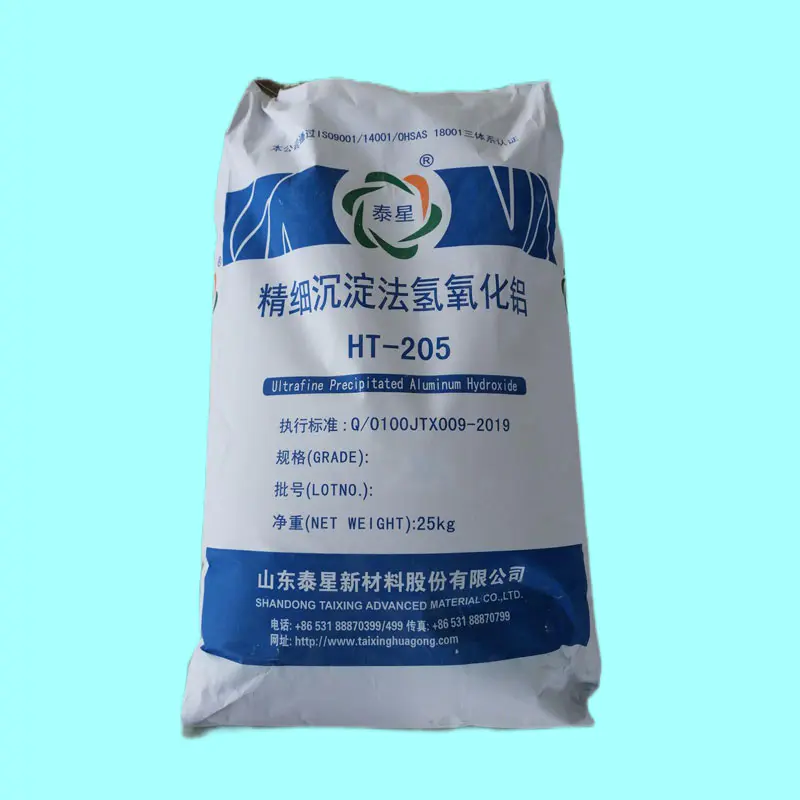
Aluminum Hydroxide


II. Material Selection and Preprocessing: The Precise Starting Point

1. Key Performance Indicators for Nanoprecipitation ATH

· Particle size and morphology: Prefer near-spherical or regular hexagonal platelet-shaped nanoparticles. Spherical particles exhibit isotropy, with a simple scattering model; hexagonal platelet-shaped nanocrystals of specific thickness can also minimize scattering when oriented parallel to the light direction.

Sodium ion residue: Control Na⁺ content < 50 ppm to avoid catalyzing the hydrolysis degradation of PC during high-temperature processing.

2. Selection and Stabilization of PC Matrix

Optical-grade PC resin: Select grades with low impurities, low discoloration, and narrow molecular weight distribution, with an initial light transmittance of >88%.

Hydrolysis stabilizers and antioxidants: Epoxidic compounds and phosphite ester antioxidants must be added in advance to protect the stability of ester bonds during processing in the presence of ATH.


Ⅲ. Performance Regulation and Synergistic Mechanism

1. Flame Retardant Mechanism (Synergistic Effect)

Nano-ATH does not act in isolation within PC

Physical barrier: During combustion, nanoparticles migrate to the molten PC surface and, in synergy with the carbon layer formed by PC's own decomposition, create a dense "Al₂O₃-carbon" composite protective layer.

2. Optical Performance Retention Mechanism

Refractive index matching: By surface modification, the refractive index difference (Δn) at the ATH-polymer interface is reduced below 0.01. According to scattering theory, the scattering cross-section is proportional to (Δn)², thereby achieving "optical transparency.".

Eliminate agglomerates: Agglomerates are the primary source of light scattering. The core objective of the aforementioned interface and dispersion process is to achieve a dispersed state where primary nanoparticles serve as the basic units.


Ⅳ. Comprehensive performance characterization and design verification

1. Optical performance: Use a haze meter and spectrophotometer to characterize the total light transmittance (TT) and haze. Target: TT>82%, Haze<8%.

2. Flame retardant performance: UL-94 vertical combustion (V-0 for thicknesses of 1.6mm and above), ultimate oxygen index (LOI>30%). Combined with cone calorimetry (CONE) analysis of peak heat release rate (pHRR) and total heat release (THR), evaluate the true fire hazard.

3. Interface and decentralized evaluation:

·High resolution TEM: visually observe the dispersion state of nanoparticles and the thickness of the interfacial layer.

·Dynamic rheology: In the low-frequency range, the plateau value of storage modulus (G ') can sensitively reflect the degree of network dispersion of nanoparticles.

4. Balance of mechanical properties: Good dispersion of nanoparticles can usually maintain a high level of notch impact strength and increase bending modulus, but attention should be paid to the balance between elasticity and rigidity.


Conclusion: System design philosophy from "addition" to "fusion"

Designing high transparency flame-retardant PC composite materials with nano precipitation ATH as the core is not simply a physical blending, but a multi-level, integrated system engineering from molecular interface design, to nanoscale dispersion control, and then to macroscopic processing induced orientation.

The key to its success lies in a deep understanding and utilization of the intrinsic properties of nano precipitated ATH (particle size, morphology, surface chemistry), achieving "optical and chemical compatibility" with PC matrix through precise interface molecular engineering, and then locking this nanoscale advantage in macroscopic products through directional processing technology. The ultimate goal is to make nano ATH no longer a "foreign object" in PC, but an invisible but indispensable component of its functional skeleton, thereby synergistically endowing the material with seemingly contradictory outstanding performance - as clear as glass and as flame retardant as rock. This marks a new stage in the design of flame-retardant polymer materials, moving from traditional "performance compromise" to intelligent "performance collaborative creation".

Related News
Leave me a message
X
We use cookies to offer you a better browsing experience, analyze site traffic and personalize content. By using this site, you agree to our use of cookies. Privacy Policy
RejectAccept