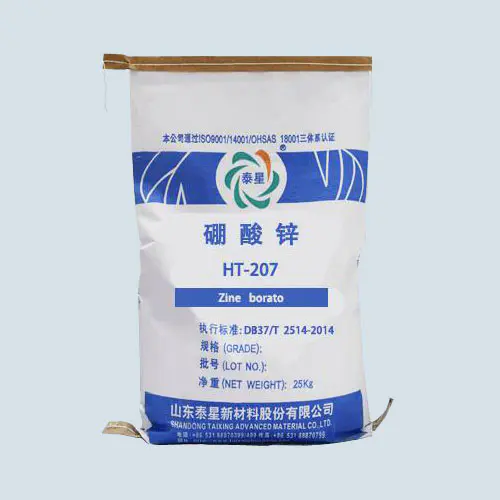
In polymer flame retardant formulation design, zinc borate is widely used as an efficient, low-toxicity, and multifunctional inorganic flame retardant. The scientific selection between hydrated forms (especially the 3.5-hydrate) and anhydrous forms constitutes a critical technical decision for engineers. This article will provide theoretical support from multiple dimensions.
3.5 Hydrated zinc borate (2ZnO·3B₂O₃·3.5H₂O)
Crystal structure: Monoclinic system, layered structure with interlayer-embedded crystalline water molecules
Theoretical moisture content: 14.5 wt%
· Critical temperature points:
· Crystalline water begins to be removed: 210±5°C
· Main dehydration range: 225-320°C
· Complete dehydration to form an anhydrous phase: >320°C
· Glass transition temperature: 400-450°C
Zinc borate (2ZnO·3B₂O₃)
Crystal structure: High-temperature stable phase, three-dimensional network structure
· Density: 3.64 g/cm³ (approximately 12% higher than hydrate type)
Thermal stability: No phase transition up to 800°C, melting point approximately 980°C
|
Performance metrics |
3.5 Hydrated Zinc Borate |
Anhydrous zinc borate |
Technical significance |
|
Refractive index |
1.58-1.62 |
1.55-1.58 |
Affects the transparency of composite materials |
|
Mohs hardness |
2.5 |
4.0-4.5 |
Determine the wear and tear of processing equipment |
|
BET specific surface area |
8-12 m²/g |
3-5 m²/g |
Affects dispersibility and surface modification efficiency |
|
oil absorption value |
28-35 g/100g |
18-23 g/100g |
The influence of characterization on resin fluidity |
Phase I: Cooling and Dilution Effect (200-320°C)
Hydrated water absorbs heat and evaporates:
ΔH_dehydration≈ 280 J/g
Dilute the oxygen concentration with water vapor in the gas phase to reduce the temperature in the combustion zone
Phase II: Formation of carbon under Lewis acid catalysis (320-500°C)
The dehydration product reacts with the HCl released by PVC:
Zn₂B₆O₁₁+ 12HCl → 2ZnCl₂ + 6BCl₃ + 6H₂O↑
The generated ZnCl₂ acts as a strong Lewis acid, catalyzing the dehydrogenation and cross-linking of polymers
[Polymer]-H+ ZnCl₂ → [Polymer] + ZnHCl₂
The carbon layer growth rate increased by 40-60%
Stage 3: Formation of the glass barrier (>500°C)
Formation of B₂O₃ glassy body, dynamic viscosity-temperature relationship:
η(T)= A·exp(E_a/RT)
At 700°C, η≈10³ Pa·s, forming an effective oxygen barrier
Single-stage glass barrier mechanism
Zinc borate without water directly participates in the formation of the B₂O₃ glass phase:
2ZnO·3B₂O₃+ 6HCl → 2ZnCl₂ + 3B₂O₃ + 3H₂O↑
Key features:
There is no low-temperature heat absorption process, and all the heat is used for polymer degradation
The glass phase forms at a higher temperature (>450°C)
The carbonization catalytic activity depends on external acid sources (such as HCl from PVC decomposition)
In a typical PVC cable compound formulation (25 phr flame retardant):
|
Test project |
3.5 Hydrated Zinc Borate |
Anhydrous zinc borate |
variance analysis |
|
LOI value |
32.5% |
28.0% |
Dehydration and heat absorption increase oxygen index |
|
UL94 rating |
V-0 |
V-1 |
Difference in carbonization rate |
|
Smoke density (D_s) |
180 |
220 |
The smoke suppression effect of water vapor |
|
Peak heat release rate |
185 kW/m² |
225 kW/m² |
Difference in cooling effect |
PVC processing scenario (typical processing temperature 170-200°C)
·3.5 Hydrated type: Stable at processing temperature, without premature dehydration
·Anhydrous type: No risk of thermal decomposition, but attention should be paid to high-temperature shear heating
High temperature processing scenarios for engineering plastics
·PBT/PA6 processing (240-280°C):
·3.5 Hydrated type: partially dehydrated (15-20%), may produce microbubbles
·Anhydrous type: completely stable, suitable for thin-walled products
·PPS/PEEK processing (320-380°C):
·3.5 Hydrated type: completely dehydrated, actually converted into anhydrous phase
·Anhydrous type: direct use, predictable performance
Performance in PVC plastisol (plasticizer content 50 phr):
-Initial viscosity: increased by 8-12%
-Thermal aging viscosity stability: excellent (without catalytic degradation)
-Storage period:>6 months
Anhydrous zinc borate:
-Initial viscosity: increase by 4-6%
-Potential risk: The generation of trace amounts of ZnCl ₂ may catalyze the hydrolysis of plasticizers
|
Electrical parameters |
3.5 Hydrated Zinc Borate |
Anhydrous zinc borate |
Test Standard |
|
volume resistivity |
2.3×10¹⁴ Ω·cm |
1.8×10¹⁴ Ω·cm |
IEC 60093 |
|
Dielectric constant (1 MHz) |
4.2 |
4.5 |
ASTM D150 |
|
Dielectric loss factor |
0.0035 |
0.0042 |
ASTM D150 |
|
Breakdown strength |
28 kV/mm |
25 kV/mm |
IEC 60243 |
Mechanism analysis: The ordered structure of crystal water reduces ion migration rate, and the micropores generated during dehydration are filled with B₂O₃ glass phase, forming a denser insulation structure.
Comparison in EPDM cable sheath (with an addition of 30 phr):
3.5 Hydrated Zinc Borate:
-Tensile strength retention rate: 92%
-Fracture elongation retention rate: 88%
-Compression permanent deformation: improved by 15%
Anhydrous zinc borate:
-Tensile strength retention rate: 96%
-Fracture elongation retention rate: 82%
-Hardness increase:+5 Shore A
Ecotoxicity:
·Both meet RoHS/REACH requirements
·3.5 Hydrated type: Bioavailable zinc ion release rate<0.1 ppm (pH=7)
·Anhydrous type: Zinc ion release rate<0.08 ppm
Burning toxicity:
3.5 Hydrated type releases water vapor in the early stages of combustion, diluting CO concentration by 30-40% and significantly reducing acute inhalation toxicity.
Synergistic with aluminum hydroxide/magnesium
·3.5 Hydration type: dehydration temperature matched with Al(OH)₃ (~220°C), synergy index 1.25
·Water free type: synergy index 1.08
Synergistic effect with phosphorus nitrogen based flame retardants
·3.5 Hydration type: promotes graphitization of the carbon layer, increasing residual carbon content by 35%
·Anhydrous type: mainly used as a ceramic precursor, with better high-temperature stability
|
Cost item |
3.5 Hydrated Zinc Borate |
Anhydrous zinc borate |
|
Raw material cost |
Benchmark |
high 15-20% |
|
Processing energy consumption |
Low (less cooling demand) |
standard |
|
Performance premium |
Smoke suppression and low toxicity value |
High temperature performance value |
|
Comprehensive cost-effectiveness index |
1.00 |
0.85-0.95 |
Formula for low smoke halogen-free cable material
EVA (VA content 28%): 100 phr
Magnesium hydroxide: 80 phr
3.5 Hydrated Zinc Borate: 25 phr
Silicone masterbatch: 5 phr
Lubricant: 2 phr
Expected performance: Smoke density<150, LOI>38%, According to IEC 61034
High temperature engineering plastic connector
PBT (containing 30% fiberglass): 100 phr
Anhydrous zinc borate: 15 phr
Melamine cyanurate: 8 phr
Anti drip agent: 0.3 phr
Expected performance: CTI>600V, GWIT 850°C, maintaining liquidity
PVC wire insulation material (UL standard)
3.5 Hydration type scheme:
-Advantage: Burning through UL 1685 vertical cable bundle
-Addition amount: 18 phr+ Sb₂O₃ 6 phr
Water free solution:
-Advantage: Elongation rate remains>70% after long-term thermal aging (136°C)
-Addition amount: 15 phr+10 phr of phosphorus based flame retardant
The selection of 3.5 hydrated and anhydrous zinc borate is not simply a performance evaluation, but a systematic optimization of flame retardant requirements, processing constraints, and cost structure. The key decision-making factors should follow the following priorities:
1. Temperature matching principle: The relative position between processing temperature and dehydration temperature determines the basic selection
2. Principle of complementary mechanism: The hydrated type provides multi-stage protection, while the anhydrous type focuses on high-temperature barriers
3. Performance cost ratio: Hydrated polymers provide better overall cost-effectiveness in most polymers
4. Regulatory driven: increasingly strict requirements for low smoke and low toxicity tend to favor hydration based solutions