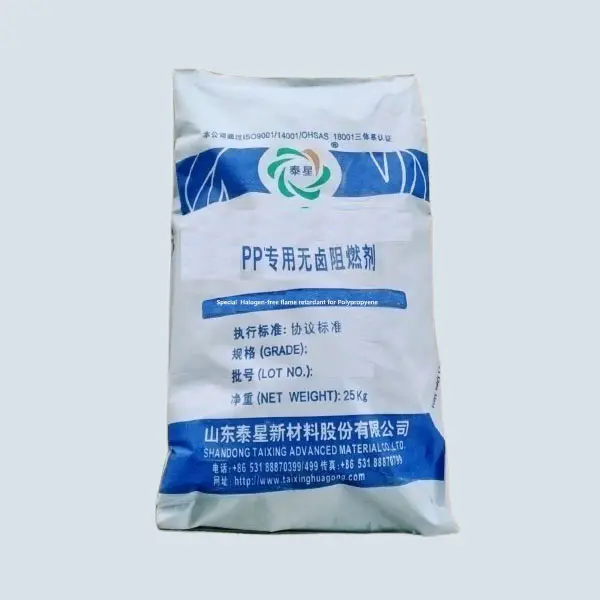
In the practice of halogen-free flame retardancy for polypropylene (PP), the "addition amount" is the core parameter determining the final material performance and cost-effectiveness. However, there is no universal "optimal addition amount," as its value results from a complex balance among flame retardant technology routes, target performance levels, polymer matrix characteristics, and cost constraints. This paper will start from the chemical essence of halogen-free flame retardancy to establish a scientific decision-making logic for the addition amount, aiming to address two key questions: "Why do different formulations exhibit vastly different addition amounts?" and "How to determine your specific addition amount?".
The halogen-free flame retardancy of PP primarily relies on two distinct technical pathways with different mechanisms, and the required addition amounts differ by orders of magnitude.
· Representative flame retardants: magnesium hydroxide (MDH), aluminum hydroxide (ATH). MDH is preferred due to its higher decomposition temperature (~340°C), which better matches the processing temperature of polypropylene (PP).
· Flame retardation mechanism: Achieve physical dilution of combustibles through high filling; during decomposition, absorb heat and cool (Mg(OH)₂ → MgO + H₂O↑), releasing steam to dilute oxygen and flammable gases.
Typical addition range: To achieve UL94 V-0 rating, an extremely high dosage is typically required.
· ATH: The addition amount >60% (approximately 60-70 phr). Due to its low decomposition temperature (~200°C) and insufficient efficiency, it is less commonly used in PP.
· MDH: Addition amount >55% (approximately 55-65 phr). This is the fundamental threshold for achieving effective flame retardancy.
The cost of high additive content: It severely compromises the mechanical properties of materials (especially impact toughness), processing fluidity, and density. It must be complemented with advanced surface modification and toughening techniques.
·Representative system: A classic ternary system with ammonium polyphosphate (APP) as the acid source, pentaerythritol (PER) as the carbon source, and melamine (MEL) as the gas source.
·Flame retardant mechanism: APP catalyzes the dehydration of carbon forming agent to form a carbon layer during combustion, while the gas source decomposes to release inert gas, forming an expanded, dense and porous carbon foam layer to isolate heat and mass transfer. This is an efficient chemical synergy.
·Typical addition range: The total addition amount is significantly lower than the mineral filling route, usually between 25% -35% (i.e. 25-35 phr).
·Technical advantages and challenges: Achieving V-0 at relatively low addition levels with minimal impact on material physical properties. However, its water resistance, anti drip properties (requiring PTFE), and long-term thermal stability are key challenges.
Under the framework of the two main paths mentioned above, the specific amount of formula added is finely regulated by the following variables:
·Level upgrade: Upgrading from UL94 V-2 to V-0 typically requires an increase of 5-15% in the total amount of flame retardant. V-0 requires strict self extinguishing and anti dripping properties.
·Thickness reduction: Achieving the same level on thinner specimens (such as 0.8mm vs. 1.6mm) typically requires higher concentrations of flame retardants or better synergistic efficiency. This is a rigorous test of formula technology.
·Particle size and surface treatment: Ultra fine, surface modified MDH or microencapsulated APP (MC-APP) has a higher specific surface area and better dispersion/compatibility. Its flame retardant efficiency is higher, and the addition amount can be reduced by 3-8% to achieve the same effect.
·The role of synergists:
·In the MDH system, the addition of synergists such as zinc borate, nanoclay, and red phosphorus can reduce the total amount of MDH added by 5-15% by promoting char formation and enhancing the char layer.
·In the IFR system, synergists such as zeolite, metal oxides, and organosilicon can improve the quality of the carbon layer and enhance efficiency.
·Homopolymer PP vs. Co polymer PP: Co polymer PP (usually PP-R or impact copolymer) itself contains a rubber phase, with a slightly higher oxygen index and better ability to accommodate flame retardants. Sometimes, it can save a small amount of flame retardants (2-5%) compared to homopolymer PP.
·Melt Flow Rate (MFR): PP with high MFR has good flowability, but it may exacerbate the droplet formation of flame retardants during combustion, sometimes requiring a slight increase in anti drip agents or flame retardants to balance.
This is the key balance point that determines whether it can be applied. The amount of addition is approximately inversely proportional to the material properties:
·Impact strength: It is usually the most sensitive indicator. The higher the amount added, the greater the brittleness. It is necessary to compensate by adding elastomers such as POE and EPDM (5-15%).
·Tensile strength and bending modulus: Rigid fillers such as MDH can increase modulus but may decrease tensile strength; The IFR system typically leads to a decrease in both.
·Density: High addition of MDH will significantly increase the material density (>1.6 g/cm ³), while the IFR system has a relatively small impact (~1.1-1.3 g/cm ³).
Halogen free flame retardants are the main cost item in formulations. We must seek the optimal solution between "achieving performance standards" and "controllable costs".
| Target scenario | Recommended technical route | Typical total addition amount (phr) | Core performance characteristics | Key Balance Point |
| Low cost universal flame retardant PP (V-2) | High Fill MDH (Basic Type) | 50 - 60 | High density, poor toughness, and poor fluidity | Cost vs. Performance |
| High performance halogen-freeV-0 PP (1.6mm) | Synergistic MDH system (MDH+synergist+toughening agent) | 50 - 65 (MDH) + 5-10 (Synergistic effect/toughening) | The overall performance is acceptable, but the density is still high | Flame retardant efficiency vs. mechanical retention rate |
| Thin walled product V-0 PP (0.8mm) | Efficient IFR system (APP/PER/MEL+) | 28 - 35 | Low density, good fluidity, water resistance is a challenge | Flame retardant efficiency vs. environmental reliability |
| High impact flame-retardant PP | IFR or synergistic MDH+high content toughening agent (15-20%) | IFR: 30-40; MDH: 55-70 (Containing toughening) | Excellent impact strength, high cost | Resilience vs. flame retardant stability |
| Low density flame retardant PP | Efficient IFR+lightweight filler | 25 - 32 | Density<1.2, moderate mechanical strength | Density vs. flame retardancy and strength |
Note: phr=parts per hundred parts by weight of resin. All data are within the empirical starting range and require experimental verification.
·List hard indicators: target UL94 grade and test thickness, minimum requirement for impact strength, target density or cost ceiling.
·Determine the technical route: prioritize IFR (if water resistance requirements are not high) to achieve better overall performance; If the cost is extremely sensitive and the requirements for density/toughness are loose, the MDH route can be considered.
·Design a multi-level experiment based on the reference range in the third section of this article.
·For example, for the IFR route, three basic formulas with total addition amounts of 28, 31, and 34 phr were designed.
·For each formulation system test: 1) flame retardant performance (UL94, LOI); 2) Key mechanical properties (cantilever beam impact, tension); 3) Processing performance (melt index, MFR).
·Draw the data into a performance addition curve graph to visually display the "inflection point".
The amount of PP halogen-free flame retardant added is essentially a solution to a multi-objective optimization problem. It does not exist in any fixed table of the manual, but exists in the multidimensional performance space defined by your specific product requirements.
·For mineral filling systems, the amount of addition is the "filling cost" that must be paid to overcome their inherent flame retardant efficiency deficiency, and the core contradiction lies in the confrontation between flame retardancy and mechanical properties.
·For expandable systems, the addition amount is the "critical threshold" for achieving sophisticated chemical synergy, and the core contradiction lies in the balance between flame retardant efficiency and environmental tolerance (water resistance, heat resistance).
Therefore, the most professional answer for material engineers is: "The amount of PP halogen-free flame retardant added is found through scientific experiments within the performance boundary you set, to achieve the optimal balance of 'flame retardancy mechanics processability economy' in the system solution. It typically falls within a broad range of 25% -35% (IFR system) or 50% -65% (efficient MDH system), and your task is to converge it to a specific value that satisfies all constraints through precise design. ”
Are you developing halogen-free flame retardant formulations for specific PP applications such as thin-walled electrical enclosures, high impact components, low-density cables, and need to determine the optimal dosage? We can provide complete development services from technology route selection, benchmark formula design, DOE based experimental optimization to final performance verification, helping you accurately and efficiently identify the best solution.