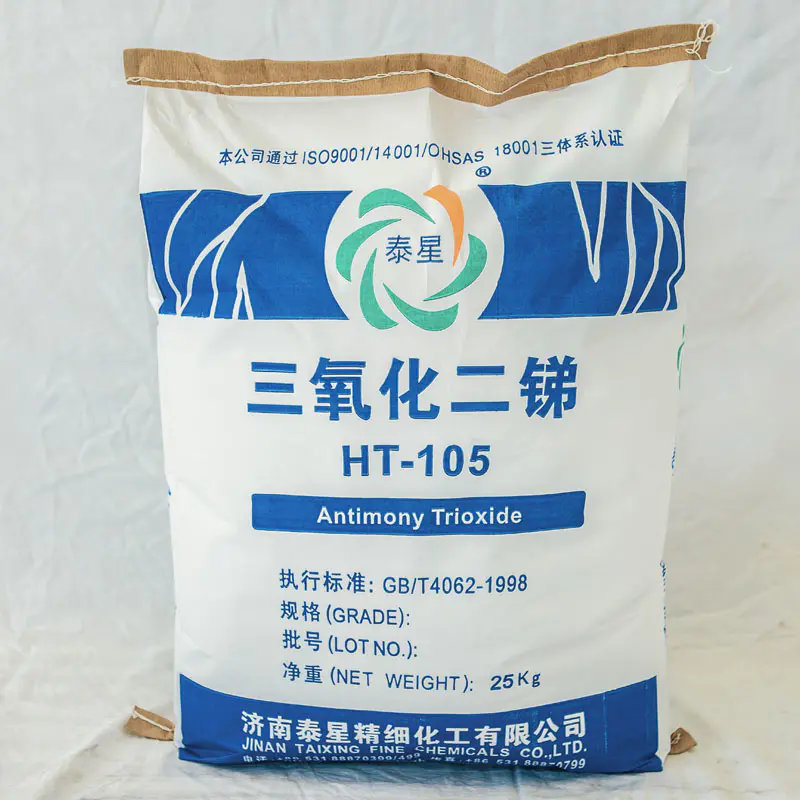
Antimony trioxide (Sb₂O₃) is the most widely used and cost-effective inorganic synergistic flame retardant in the global flame retardant material system. Relying on the antimony halogen synergistic flame retardant mechanism, it is indispensable in fields such as plastics, rubber, fibers, coatings, electronics and electrical equipment, wires and cables, and building materials. This article is based on the general calculation logic of the international flame retardant industry, and systematically explains the amount of Sb₂O₃ added.
Antimony trioxide itself has limited flame retardancy, and its core value lies in the significant synergistic effect with halogen-based flame retardants (chlorine-based, bromine-based). The premise for calculating the addition amount is a deep understanding of this mechanism:
1. Gas phase free radical capture: At high temperatures, Sb₂O₃ reacts with hydrogen halide (HX) to generate antimony trihalide (SbX₃), capturing combustion free radicals (H ·, OH ·) and interrupting the combustion chain reaction;
2. Condensed phase carbon insulation: promotes the formation of a dense carbon layer on the surface of the substrate, isolates oxygen and heat, and inhibits smoke release;
3. Chemical stoichiometry core: The reaction equation Sb₂O₃ + 6HX → 2SbX₃ + 3H₂O determines the optimal molar ratio of halogen to antimony to be 3:1~4:1, with a mass ratio of approximately Br: Sb=2.5~3.5:1. This is the core basis for calculating the amount of addition.
Theoretically, according to the reaction Sb₂O₃ + 6HX → 2SbX₃ + 3H₂O, the optimal molar ratio of antimony (Sb) to halogen (X) for complete reaction is 1:3.
1. Determine the target: clarify the flame retardant grade (V-0/V-1/V-2), substrate type, processing technology, and environmental standards (RoHS/REACH);
2. Select halogenated flame retardants: Determine the type (decabromodiphenyl ethane, chlorinated paraffin, etc.) and effective halogen content;
3. Substitute into the formula: Calculate the basic addition amount of Sb₂O₃ based on the ratio of halogen to antimony;
4. Correction and adjustment: Fine tune according to particle size, processing temperature, filler, and environmental requirements;
5. Validation optimization: Determine the final addition amount through combustion testing and mechanical testing.
-Substrate characteristics: Contains chlorine itself, with extremely high synergistic efficiency;
-Calculation logic: No additional chlorine is required, calculate directly according to the flame retardant level;
-Recommended dosage: 3-6 phr (V-0 grade: 4-5 phr; Ordinary flame retardant: 3 phr);
-Compliance Reminder: The EU/North America restricts lead arsenic impurities and prefers high-purity Sb₂O₃ (As ≤ 0.05%, Pb ≤ 0.005%).
-Substrate characteristics: high elasticity, requiring a balance between flame retardancy and flexibility;
-Recommended dosage: 4-10 phr (high flame retardant sheath: 5-6 phr);
-Suggestion for compounding: Mix with zinc borate to reduce the amount of Sb₂O₃ by 20-50% and decrease smoke.
-Coating: 2-5 wt% (fireproof coating: 4-5 wt%);
-Textiles: 3-6 wt% (coating finish);
-Fiberglass reinforced plastic: 3-5 phr (with halogen resin).
-Purity ≥ 99.8%: the addition amount is reduced by 5-10%, and the dispersibility is better;
-Ultra fine/nano scale (0.3~1 μ m): with a larger specific surface area, the flame retardant efficiency is improved by 15-30%, and the addition amount is further reduced.
-EU RoHS/REACH, California 65: Restrictions on heavy metal impurities, requiring high-purity Sb₂O₃;
-Low smoke and halogen-free scenario: partially replaced with zinc borate/aluminum hydroxide, reducing Sb₂O₃ by 30-50%.
-Processing temperature>200 ℃: Choose heat stable Sb₂O₃ to avoid decomposition;
-High mechanical requirements: Control the addition amount to ≤ 6 phr to prevent tension/impact drop.
-Sb₂O₃+zinc borate: synergistically enhances efficiency, reduces addition amount, and suppresses smoke;
-Sb₂O₃+phosphorus based flame retardant: halogen-free/low halogen system, suitable for environmental upgrades.
Correction: The amount of halogenated substrate (PVC) added is much lower than that of halogen-free substrate (PP/ABS).
Correction: The addition amount of low purity/coarse particle size needs to be increased, which increases costs and affects performance.
Accurately calculating the amount of antimony trioxide added is the core technical link in the design of material flame retardant formulas, which directly determines product performance, cost, and global market access.