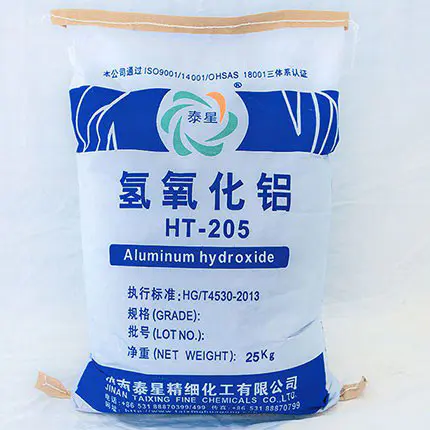
In the field of flame retardant and functional fillers, aluminum hydroxide (ATH) holds a pivotal position. However, the differences in its preparation processes—namely the "bottom-up" precipitation method and the "top-down" grinding method—fundamentally determine the physicochemical nature and application performance boundaries of the products. This distinction is far from a simple "difference in particle size," but stems from fundamental disparities across the entire path from atomic arrangement to particle assembly.
The precipitation method is a "bottom-up" wet chemical synthesis process. By precisely controlling supersaturation, pH, temperature, and additives, the aluminum ions (Al³⁺) and hydroxide ions (OH⁻) undergo a crystallization pathway of "nucleation-growth-maturation," ultimately assembling from the atomic/molecular level into aluminum hydroxide particles.
Core characteristics: This is a crystal growth process governed by thermodynamics and kinetics.
The grinding method is a "top-down" physical processing technique. The raw material typically consists of coarse ATH particles produced from natural bauxite via the Bayer process. Through mechanical crushing (such as ball milling or jet milling) and classification, the macroscopic large particles are "broken down" to the target size.
Core characteristics: This is a mechanically dominated process of particle fragmentation and differentiation.
| performance metrics | Precipitation method ATH | Grinding method ATH |
| flame retardant efficiency | High: Highly active surface promotes catalytic carbonization; Narrow distribution ensures uniform performance. | Generally, due to the influence of impurities and dispersibility, the addition amount usually needs to be higher. |
| Optical performance (transmittance) | Advantage: Spherical nanoscale products can achieve high transparency and low haze. | Poor: Irregular large particles cause strong light scattering and the material is opaque. |
| Electrical performance (dielectric loss) | Excellent: Ultra high purity, extremely low ion impurities, suitable for high-frequency electrons. | Restricted: High sodium content leads to increased ion conductivity and dielectric loss. |
| Influence on mechanical properties | Enhancement and toughening: Nano dispersion can simultaneously improve modulus and impact strength. | Brittle risk: Irregular coarse particles can easily act as stress concentration points. |
| System viscosity | Low: Spherical particles have good flowability and can achieve high filling and low viscosity. | High: Irregular particles have high internal friction and significant thickening effect. |
The application scenario involves highly cost-sensitive general-purpose flame-retardant materials (such as carpet backings and ordinary wires and cables).
There are no special requirements for the optical, electrical, or mechanical reinforcement properties of the material.
The process tolerance is relatively high, allowing for certain performance fluctuations and higher additive levels.
The application scenarios include high-end electronic materials (copper-clad laminates, encapsulation adhesives), high-performance composite materials (aerospace, rail transit), and transparent/super-thin flame-retardant products (LED encapsulation, transparent PC).
The materials are required to possess excellent electrical insulation, low dielectric loss, high thermal conductivity, or optical transparency.
Strive to achieve higher flame retardancy with lower additive amounts while simultaneously enhancing or maintaining the mechanical properties of the matrix.
The production process demands extremely high batch stability and consistency.
The difference between precipitated ATH and ground ATH is essentially the distinction between "material synthesis" and "material processing," which reflects the difference between "design for functionality" and "production for specifications.".
Therefore, this choice is not merely a simple cost-benefit trade-off but a strategic decision involving technical pathways and product positioning. Under the trend of industrial upgrading and material high performance, the "designability" and "extreme performance" represented by the precipitation method are gradually transforming it from a premium option into an indispensable choice in high-end applications. Understanding this fundamental distinction serves as the cognitive cornerstone for precise material selection and achieving product innovation.