Shandong Taixing Advanced Material Co., Ltd.
News

What Is the Smoke Suppression Mechanism of Zinc Borate?

2026-01-23 0 Leave me a message

In fire safety science, "smoke suppression" and "flame retardancy" are equally important but have different mechanisms as the core objectives. Zinc borate (taking the most commonly used 2ZnO·3B₂O₃·3.5H₂O as an example) is widely recognized as an efficient smoke suppressant synergist. Its outstanding performance is not due to a single action, but rather the result of a multi-stage, multi-scale chemical and physical synergy that occurs simultaneously in the condensed phase and gas phase, and runs through the entire combustion process. This article will systematically analyze how to control the generation and release of smoke from the source by constructing a "three-dimensional smoke suppression network".


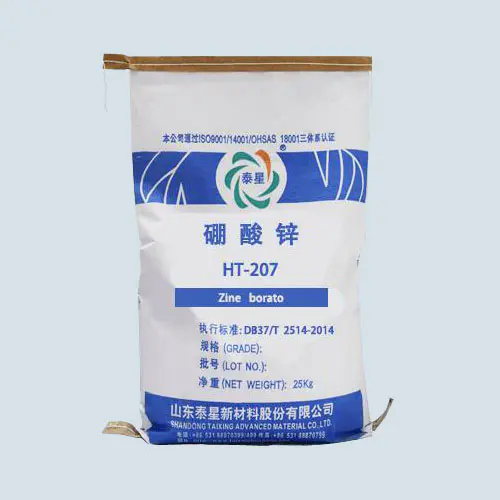
Zinc Borate


I. Core understanding: The mechanism differentiation between smoke suppression and flame retardancy

Firstly, it should be clarified that smoke is mainly an aerosol composed of suspended carbon particles (soot) and condensed organic droplets generated by incomplete combustion of polymers. Therefore, the core of smoke suppression lies in:

1. Promote complete oxidation and reduce the generation of carbon particles.

2. Capture and fix carbon particles to prevent their escape.

3. Change the combustion reaction pathway to reduce organic volatile matter.

Zinc borate is developing its systematic smoke suppression project around these three points.


II. Deep analysis of multi-stage smoke suppression mechanism

The smoke suppression effect of zinc borate can be clearly divided into three temperature driven continuous stages, which can be accurately verified through smoke density testing using thermogravimetric infrared spectroscopy (TGA-FTIR) and cone calorimeter.

Phase 1: Low temperature dehydration and "cooling dilution" effect (~290 ° C -350 ° C)

In this temperature range, zinc borate releases its crystal water:


Zinc Borate


·Mechanism and function:

·Cooling: The evaporation of water is a strong endothermic process that effectively cools the polymer matrix, slows down its thermal decomposition, and thus reduces the generation rate of combustible gases and smoke precursors.

·Physical dilution: The released water vapor dilutes the concentration of volatile pyrolysis products and oxygen in the flame zone, which not only helps to suppress combustion but also promotes gas-phase oxidation of some condensable volatile components, making them more inclined to be converted into CO ₂ and H₂O rather than soot.


Phase 2: Formation of molten glass layer and "physical coverage/catalytic oxidation" effect (~350 ° C-500 ° C)

This is the most critical step in suppressing smoke with zinc borate. After dehydration, zinc metaborate (2ZnO·3B₂O₃) melts to form a viscous, impermeable boron zinc oxygen glassy melt, covering the surface of the polymer and the carbon layer being formed.

·Mechanism and function:

1. Physical barrier and capture: This layer of molten glass is like a "sticky filter", which can effectively capture and encapsulate carbon particles (soot) and tar like macromolecules that are escaping from the polymer body, locking them in the condensed phase and preventing them from entering the gas phase to form smoke.

2. Catalytic oxidation: Molten borates are excellent oxidation catalysts. It can catalyze the deep oxidation of carbon particles and organic fragments captured by it at the condensed gas phase interface, converting them into CO ₂, thereby directly "eliminating" potential smoke substances at the source.

3. Promoting Charcoal Formation: This glass layer can stabilize and enhance the structure of the expanded char layer. A more complete char layer means less pyrolysis combustibles are produced, indirectly reducing smoke emissions.


Phase 3: "Stable Barrier" Effect of Solid Phase Residues (>500℃)

At higher temperatures, the system ultimately forms a stable, porous but robust residual layer of zinc borate/carbon/metal oxide composite ceramics.

·Mechanism and function: This residual layer has extremely high thermal stability and can serve as a long-lasting barrier for thermal insulation, preventing further decomposition of internal materials and the later generation of smoke, ensuring the long-term effectiveness of smoke suppression.


III. Synergistic effect: interaction with halogens and metal hydroxides

The smoke suppression ability of zinc borate is significantly enhanced when compounded with other flame retardants, reflecting its core value as a synergistic agent.

·Synergistic effect with halogens (such as Cl in PVC):

·In halogenated systems, zinc borate can react with released hydrogen halides (HCl) to produce zinc chloride (ZnCl ₂) and boron oxychloride.

·ZnCl ₂ is a stronger Lewis acid catalyst that can catalyze crosslinking and aromatization reactions of polymers (such as PVC) more vigorously, promoting the rapid formation of a dense char layer (i.e. "catalytic char"), thereby inhibiting the generation of soot at an earlier stage. This is a classic "boron zinc halogen" ternary synergistic smoke suppression mechanism.

·Synergistic effect with metal hydroxides (ATH/MDH):

·There is a good correlation between the decomposition temperature of zinc borate and ATH/MDH. ATH/MDH decomposes and absorbs heat, dehydrates and suppresses smoke at lower temperatures (~200-300℃), while zinc borate continues to function at higher temperatures (~300-500℃), forming a "temperature relay" and expanding the effective temperature range of the entire smoke suppression effect.


IV. Key factors affecting smoke suppression efficiency

1. Particle size and dispersion: Ultra fine and uniformly dispersed zinc borate can provide a larger reaction specific surface area, making the molten glass layer cover more quickly and densely, and have higher smoke suppression efficiency.

2. Hydration state: The decomposition temperature and melting behavior of trihydrate, monohydrate, and anhydrous zinc borate are different, and matching selection should be made based on the decomposition temperature of the polymer matrix to optimize stage synergy.

3. Addition amount: There is an optimal addition amount window. Too low to form a continuous and effective coverage layer; Excessive values may affect the mechanical properties of materials and no longer significantly improve smoke suppression efficiency.


V. Performance verification: from mechanism to data

Cone calorimeter testing is the gold standard for quantifying smoke suppression performance. Adding high-quality zinc borate polymer materials usually results in the following data changes:

·The specific extinction area (SEA) and smoke generation rate (SPR) have significantly decreased (up to 30% -60%).

·The total smoke release (TSR) significantly decreased.

·The microstructure of residual carbon (SEM observation) shows a denser, continuous, and glassy surface structure.


Conclusion: A "systematic" smoke control plan

In summary, the smoke suppression mechanism of zinc borate is not a simple result of a single chemical reaction, but rather a carefully designed "multi-stage defense system":

·Early stage (endothermic dilution): Delaying the production of smoke precursors through physical and chemical means.

·Mid stage (melt catalysis): Capture and convert smoke particles at the interface through physical trapping and chemical catalysis.

·Later stage (stable barrier): By forming stable residual carbon, it prevents the continuous generation of smoke.

It perfectly embodies the role of a "synergistic agent" - it can independently exert excellent smoke suppression function in halogen-free systems, and can also enhance the overall smoke suppression and flame retardant efficiency of the system to a new height through chemical reactions with other components in halogenated or inorganic filling systems.

Therefore, for material designers who pursue higher fire safety levels (not only non combustible, but also low smoke and low toxicity), zinc borate is not an option, but a necessary option based on a global perspective of combustion chemistry. It represents an advanced design concept from passive flame retardant to active, clean and fire-resistant.

Do your polymer materials need to comply with strict smoke toxicity standards (such as EN 45545, NFPA 130)? We can provide a complete solution from the selection of the best model of zinc borate, the design of compounding schemes, to the verification of the smoke suppression performance of a complete set of cone calorimeter, helping your product achieve dual leadership in safety and environmental protection dimensions.


Related News
Leave me a message
X
We use cookies to offer you a better browsing experience, analyze site traffic and personalize content. By using this site, you agree to our use of cookies. Privacy Policy
RejectAccept