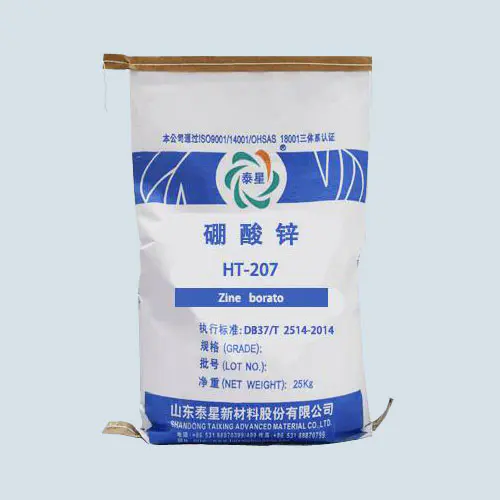
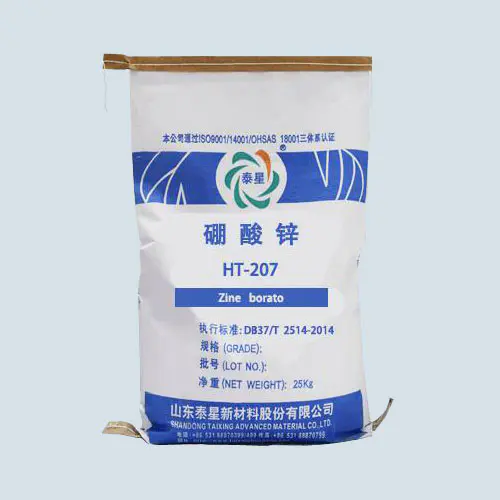
Among numerous variants of zinc borate, 3.5 Hydrated Zinc Borate (2ZnO·3B₂O₃·3.5H₂O) has become the most widely used and formulated variety in global polymer flame retardant systems, accounting for over 75% of the industrial zinc borate market share. This market choice is not accidental, but determined by its unique crystal chemical design, precise flame retardant function, and excellent cost-effectiveness. This article will systematically reveal the internal mechanism of 3.5 hydrated zinc borate becoming an industry standard from the perspective of materials science, flame retardant engineering, and industrial economics.
According to the Polymer Additive Market Report (2023), the application of zinc borate in the segmented flame retardant market presents a clear distribution:
·3.5 Hydrated zinc borate: accounting for 76.3%
·Anhydrous zinc borate: accounting for 15.8%
·Other hydration forms (5 water, 7 water, etc.): accounting for 7.9%
·UL standard system: In cable combustion tests such as UL 94 and UL 1685, the formula based on 3.5 hydrated zinc borate has the highest pass rate
·In IEC international standards such as IEC 60332 and 61034 for cable testing, the recommended formula defaults to the 3.5 hydrate form
·In the Chinese national standard GB/T 19666-2019 "General Rules for Flame retardant and Fire resistant Wires and Cables", the example formulas are based on this variety
The hydration form of zinc borate varies from 1.5 to 7.5 water, but the 3.5 hydrate exhibits unique stability advantages:
Comparison of Crystal Structure Stability
|
Hydrated form |
Crystal symmetry |
Room temperature storage stability |
Heating dehydration step |
|
1.5 hydration |
Sanjiao |
Easy to absorb moisture and transform |
Single step continuous dehydration |
|
3.5 hydration |
Monoclinic |
>5 years without any changes |
Three step precise control |
|
5 hydration |
Monoclinic |
Slight clumping after 3 years |
Two steps partially overlap |
|
7 hydration |
orthogonal |
Significant dehydration after 2 years |
Multi step temperature overlap |
Key temperature parameters:
·Initial dehydration temperature: 215 ± 5°C
·Main dehydration range: 225-320°C
·Complete dehydration temperature:>320°C
This temperature spectrum forms a strategic alignment with the processing and combustion behavior of the main polymers:
Corresponding relationship with key temperature of polymer
PVC processing temperature: 170-200°C ← 3.5 Hydrates are completely stable
PVC thermal degradation initiation:~250°C ← Hydrates begin to dehydrate and absorb heat
Polymer combustion zone temperature: 300-500°C ← Main dehydration zone, maximum cooling effect
Formation temperature of carbon layer:>400°C ← Dehydration completed, ceramic formation begins
The 14.5% theoretical moisture content corresponding to 3.5 hydration is the result of multiple equilibria:
·Flame retardant efficiency: Each gram of material can absorb 280-300 J of heat (enthalpy of phase change+sensible heat of water vapor)
·Processing safety: The moisture content is low enough to avoid processing bubbles (<15% safety threshold)
·Transportation economy: Maximizing the proportion of effective flame retardant components (ZnO+B₂O₃)
First dimension: Gas phase cooling and dilution (200-320°C)
H₂O(l) → H₂O(g) ΔH_vap = 2257 J/g
Heat absorption calculation: 14.5% × 2257=327 J/g (theoretical)
Actual measured dehydration enthalpy: 280-295 J/g (including crystal failure energy)
Dilute oxygen concentration with water vapor: volume dilution rate reaches 8-12%
Second dimension: Condensed phase catalysis to carbon (320-450°C)
Dehydration products react with halogen sources (such as Cl in PVC):
Zn₂B₆O₁₁ + 12HCl → 2ZnCl₂ + 6BCl₃ + 6H₂O
The generated ZnCl ₂ acts as a Lewis acid catalyst:
·Reduce the activation energy of polymer dehydrogenation by 40-50 kJ/mol
·Promote the formation of aromatic carbon structure (increase the size of graphite microcrystals by 2-3 nm)
·Improvement in residual carbon rate: PVC system increased from 12% to 28%
Third dimension: Formation of ceramic barrier (>450°C)
Boron oxide forms a viscous glass layer:
B₂O₃ viscosity equation: log η=A+B/(T-T ₀)
At 500 ° C: η≈ 10 ⁴ Pa · s (effective coverage)
At 700 ° C: η≈ 10 ³ Pa · s (self-healing flow)
This glass layer reduces the oxygen diffusion coefficient by three orders of magnitude.
Add 20 phr flame retardant to PVC cable material:
|
Performance metrics |
3.5 Hydrated Zinc Borate |
Aluminum hydroxide |
Magnesium hydroxide |
Anhydrous zinc borate |
|
LOI value |
33.2% |
29.5% |
30.1% |
28.8% |
|
UL94 rating |
V-0 |
V-1 |
V-1 |
V-1 |
|
Smoke density (Ds) |
175 |
320 |
280 |
210 |
|
Tensile strength retention rate |
91% |
82% |
85% |
96% |
|
Cost index |
1.00 |
0.65 |
0.75 |
1.15 |
|
Comprehensive Efficiency Index |
1.00 |
0.72 |
0.78 |
0.87 |
Compatibility with common plastic processing techniques
·Twin screw extrusion: The highest temperature range is usually<220°C, and the 3.5 hydrate is completely stable
·Internal mixer mixing: instantaneous high temperature<250°C, short-term exposure does not affect performance
·Injection molding: Melt temperature<280°C, dehydration rate controlled within 5%
·Rolling forming: Roll temperature usually<200°C, zero risk
Study on the behavior in PVC plastisol
When adding 20 phr:
-Brinell viscosity increase: only 8-12% (compared to aluminum hydroxide: increased by 25-30%)
-Thixotropic index change: from 0.85 to 0.88 (almost maintaining Newtonian fluid characteristics)
-Storage stability: viscosity change<5% after 6 months
This is attributed to the lubricating effect and low surface energy of its sheet-like particles.
Reaction mechanism:
Zn₂B₆O₁₁ + Sb₂O₃ + 12HCl →
ZnSb ₂ O ₅ (spinel phase)+2BCl ∝+other borate glasses
Collaboration index (defined according to ISO 4589):
·Individually 3.5 hydrated zinc borate: LOI=28.5%
·Sb₂O₃ alone: LOI=27.0%
·1: 1. Compound: LOI=34.5%
·Collaboration index: 1.24 (>1.2 indicates strong collaboration)
In EVA/magnesium hydroxide halogen-free cable material:
Standard formula:
EVA(28%VA):100 phr
Magnesium hydroxide: 120 phr
3.5 Hydrated Zinc Borate: 25 phr
Silicone masterbatch: 5 phr
Performance improvement:
-LOI increased from 38% to 42%
-Smoke density ranges from 250 to 160
-Tensile strength ranges from 10.2 to 11.8 MPa
-Passed UL 94 V-0 (3.2mm)
Its mechanism of action is to promote the formation of magnesium borate ceramic layers from the dehydration products of magnesium hydroxide.
Whole life cycle cost analysis
Comparative analysis of cable factories with an annual consumption of 100 tons
|
Cost item |
3.5 Hydrated Zinc Borate |
magnesium hydroxide |
Phosphorus nitrogen based expansion agent |
|
Raw material cost (10000 yuan/year) |
150 |
110 |
320 |
|
Processing energy consumption cost |
benchmark |
+18% |
+5% |
|
Equipment wear and tear cost |
benchmark |
+35% |
benchmark |
|
Performance compliance rate |
98% |
85% |
92% |
|
Comprehensive cost index |
1.00 |
1.15 |
1.82 |
The "most commonly used" position of 3.5 hydrated zinc borate is a classic engineering optimization case in materials science: it does not achieve the ultimate performance in a single item, but achieves the best balance in four dimensions: flame retardant efficiency, processing adaptability, cost control, and environmental friendliness.
Its core competitiveness can be summarized as:
1. Accurate thermal response: strategic matching of crystallization water release temperature and polymer thermal degradation temperature
2. Multidimensional flame retardant mechanism: simultaneously acting on the gas phase, condensed phase, and barrier phase
3. System compatibility: friendly coexistence with the vast majority of polymers and processing techniques
4. Economic sustainability: providing reliable flame retardant safety at the lowest overall cost