Shandong Taixing Advanced Material Co., Ltd.
News

The Difference Between Zinc Borate Monohydrate and 3.5 Hydrate Zinc Borate

2026-05-18 0 Leave me a message

Zinc borate, as an efficient and environmentally friendly inorganic flame retardant and multifunctional additive, has been widely used in plastics, rubber, coatings, textiles and other fields. However, the commonly mentioned "zinc borate" in the industry actually includes various forms with different crystal water contents, among which the most representative are zinc borate monohydrate (ZnO·B₂O₃·H₂O) and zinc borate 3.5hydrate (2ZnO·3B₂O₃·3.5H₂O). This article will delve into the differences between the two from a professional academic perspective.


Ⅰ. The fundamental difference between chemical structure and crystal morphology

1. Structural characteristics of zinc borate monohydrate

The chemical formula of zinc borate monohydrate is ZnO·B₂O₃·H₂O, where the molar ratio of ZnO to B₂O₃ is 1:1 and the crystal water content is fixed at 1 molecule. Its crystal structure usually presents a layered or chain like arrangement, with boron atoms existing in a three coordinate or four coordinate form, forming a stable boron oxygen network. This structure has high thermal stability, and the dehydration temperature is usually between 250-300 ℃.

2. Structural characteristics of 3.5 hydrated zinc borate

The chemical formula of 3.5 hydrated zinc borate is 2ZnO·3B₂O₃·3.5H₂O, with a molar ratio of 2:3 between ZnO and B₂O₃, containing 3.5 crystalline water molecules.

Comparison of key structural differences:

·Water content difference: The crystal water content of 3.5 hydrated zinc borate is 3.5 times that of monohydrate

·Different boron zinc ratios: 1:1 for monohydrate and 3:2 for 3.5-hydrate

·Crystal symmetry: Monohydrate is usually in the monoclinic crystal system, while 3.5 hydrate is mostly in the triclinic or monoclinic crystal system


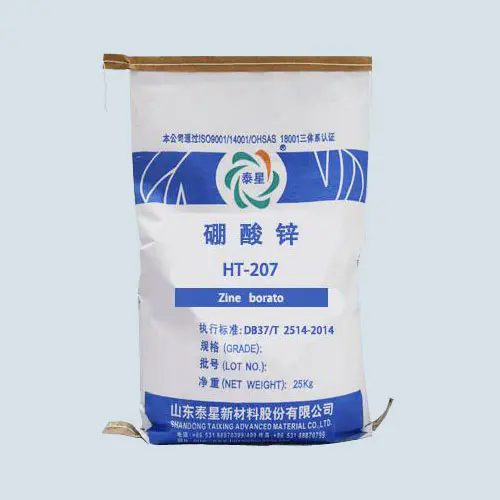
Zinc Borate


Ⅱ. Comparative analysis of physical and chemical properties

1. Thermal stability and dehydration behavior

The dehydration process of zinc borate monohydrate is relatively simple, removing the only structural water molecule within the range of 250-300℃ to form anhydrous zinc borate. This process absorbs heat significantly, which helps the material absorb a large amount of heat when heated.

The dehydration behavior of 3.5 hydrated zinc borate is more complex, exhibiting multi-stage dehydration characteristics:

·Phase 1 (100-150℃): Removal of some adsorbed water and a small amount of crystalline water

·Second stage (200-250℃): Remove most of the crystalline water

·Stage 3 (300-350℃): Complete dehydration to form amorphous zinc borate

This multi-stage dehydration process allows it to absorb heat over a wider temperature range and has a longer flame retardant efficiency.

2. Solubility and dispersibility

The solubility of zinc borate monohydrate in water is extremely low (<0.1%), and it is almost insoluble in organic solvents, which gives it good dispersion stability in polymer systems.

3.5 Hydrated zinc borate has stronger surface polarity due to its higher content of crystalline water, resulting in better dispersion in polar systems. However, surface modification treatment may be required in non-polar polymers.

3. Particle size and specific surface area

The particle size of zinc borate monohydrate is smaller (usually 1-5 μ m) and the specific surface area is larger (5-15 m ²/g), which is beneficial for its uniform dispersion in the matrix.

The particle size of 3.5 hydrated zinc borate is relatively large (usually 5-20μm), but ultrafine products can also be prepared through special processes.


Ⅲ. Flame retardant mechanism and performance differences

1. Collaborative flame retardant effect

Both types of zinc borate exert flame retardant effects through multiple mechanisms, but with different focuses:

Zinc borate monohydrate:

·Heat absorption dehydration: The dehydration temperature is high, suitable for applications that require flame retardancy in the later stage

·Forming a glassy protective layer: After dehydration, a B₂O₃ glass layer is generated to isolate oxygen and heat

·Promote carbonization: has a significant synergistic effect with flame retardants such as aluminum hydroxide

3.5 Hydrated Zinc Borate:

·Multi stage heat absorption: absorbing heat over a wider temperature range

·Release crystal water to dilute combustible gases

·The generated zinc oxide has an inhibitory effect on smoke

·The synergistic effect with halogenated flame retardants is particularly prominent

2. Comparison of smoke suppression performance

3.5 Hydrated zinc borate is usually superior to monohydrate products in suppressing smoke generation due to its higher boron content and unique dehydration characteristics, making it particularly suitable for applications with strict requirements for smoke density.


Ⅳ. Differentiated choices in application fields

1. Advantages of application of zinc borate monohydrate

·High temperature processing polymers, such as engineering plastics (PA, PBT, etc.), due to their high dehydration temperature

·Light colored products: usually have a higher whiteness (≥ 95%), suitable for products with strict color requirements

·Cable material: Excellent synergistic effect with aluminum hydroxide/magnesium

·Transparent or semi transparent products: better refractive index matching

2. Advantages and Applications of 3.5 Hydrated Zinc Borate

·PVC and halogen containing systems: significant synergistic flame retardant effect with halogens

·Rubber products: multi-stage dehydration characteristics are more suitable for rubber vulcanization process

·Fireproof coating: high boron content provides better fire resistance performance

·Textile flame retardant treatment: Low temperature flame retardant effect is better

·Places with high smoke suppression requirements: such as subways, ships, and other internal materials


Ⅴ. Key considerations in practical applications

1. processing temperature

·Processing temperature<220℃: Priority should be given to 3.5 hydrated zinc borate

·Processing temperature 220-280℃: Both options are available, choose according to other requirements

·Processing temperature>280℃: Zinc borate monohydrate should be selected

2. Synergy with other flame retardants

·Combined with inorganic flame retardants (aluminum hydroxide/magnesium): Zinc borate monohydrate usually has better effects

·When combined with halogenated flame retardants, the synergistic effect of 3.5 hydrated zinc borate is more significant

3. Physical performance impact

Due to its smaller particle size, zinc borate monohydrate usually has less impact on the mechanical properties of the material, while the 3.5 hydrate product may require finer dispersion treatment.


Conclusion

Monohydrate and 3.5-hydrate zinc borate are essentially two different compounds in chemistry, rather than a simple difference in "water content". 

Related News
Leave me a message
X
We use cookies to offer you a better browsing experience, analyze site traffic and personalize content. By using this site, you agree to our use of cookies. Privacy Policy
RejectAccept