Shandong Taixing Advanced Material Co., Ltd.
News

What Is the Proportion of DBDPE Added to Plastics?

2025-12-31 0 Leave me a message

What is the proportion of decabromodiphenyl ethane (DBDPE) added in flame retardant formula design? ”It is a core engineering problem that cannot be answered without a specific system. The "optimal ratio" is not a fixed constant, but a dynamic equilibrium point under the combined effects of the chemical properties of the polymer, target flame retardant level, synergist ratio, and cost/performance constraints. This article will abandon the practice of providing a simple "recipe table" and instead build a scientific calculation logic and optimization framework for determining the DBDPE addition ratio.

I. Core cognition: Breaking the myth of "fixed ratio"

The basic understanding that must be established first is that the flame retardant efficiency of DBDPE has a strong "system dependence".

·The efficiency of using DBDPE alone is limited: DBDPE itself mainly functions through gas-phase free radical capture (releasing Br ·), but when used alone, it often requires extremely high addition amounts (>20%) to achieve high flame retardant levels (such as UL94 V-0), which often leads to serious deterioration of the material's mechanical properties and lacks engineering application value.

·Its value lies in synergy: the truly efficient application of DBDPE is almost always combined with the synergist antimony trioxide (Sb₂O₃). The essence of its addition ratio is to determine the minimum effective concentration of the "bromine antimony synergistic reaction network" required to achieve the desired performance in a specific system.

Therefore, the core of the question lies in 'How much does DBDPE add?'? ”How to optimize the ratio and total amount of DBDPE and Sb₂O₃ in order to build an efficient bromine antimony synergistic system? ”


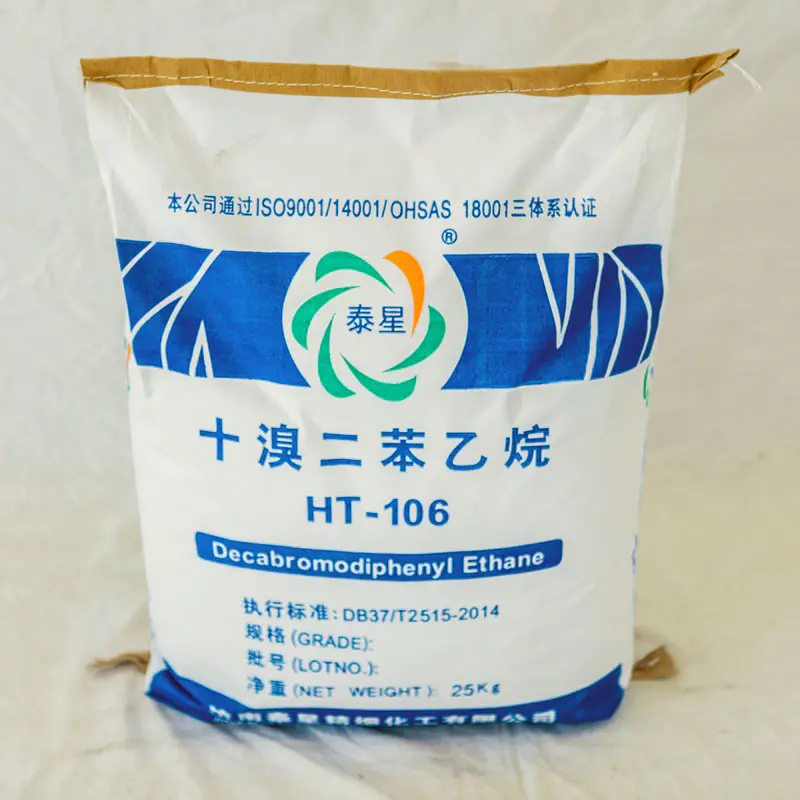
Decabromodiphenyl Ethane


II. The proportion of system dependencies added: analysis of key variables

The actual optimal ratio fluctuates around the theoretical value and is controlled by the following four key variables:

1. Intrinsic combustion behavior of polymer matrix (primary variable)

·High styrene based polymers (such as HIPS, ABS): They have a certain tendency to char and generate styrene free radicals during combustion, which can generate additional synergy with bromine/antimony systems. Therefore, it has the highest efficiency and the lowest required total addition amount. The DBDPE: Sb₂O₃ ratio is often in the range of (2.5~3.5): 1.

·Polyolefin (such as PP, PE): It is a pure carbon hydrogen chain that relies entirely on gas-phase flame retardancy and burns violently. A higher total addition amount is required, and the DBDPE ratio is usually higher, with a ratio of (3.5-5): 1, to provide sufficient bromine source.

·Engineering plastics (such as PA, PBT): They contain oxygen and nitrogen atoms and can participate in carbonization. The use of DBDPE system is not mainstream. If used, special attention should be paid to the stability under high temperature processing and the impact on mechanical properties.

2. Target flame retardant rating and testing standards

·UL94 V-0 (highest grade): The most demanding requirement is to ensure that the proportion and total amount can provide sufficient and sustained gas-phase flame retardant effect, preventing any flame burning for more than 10 seconds. Usually, it is necessary to use values near the theoretical optimal ratio and ensure excellent dispersion.

·UL94 V-2: Flame droplets are allowed, with relatively low requirements for the persistence and efficiency of gas-phase flame retardancy. The proportion of DBDPE can be higher, or the total amount can be slightly reduced.

·Thickness effect: The thinner the test sample (such as 0.8mm vs 1.6mm), the higher the concentration or better ratio of flame retardant is usually required to achieve the same level.

3. Constraints on comprehensive performance balance

·Mechanical properties: DBDPE and Sb₂O₃ are both rigid particles, and their addition can damage toughness (impact strength). On the premise of meeting flame retardant requirements, optimizing the proportion and surface treatment to pursue the lowest total addition amount is the key to protecting mechanical properties.

·Processing flowability: High addition levels will increase the viscosity of the melt. Sometimes it is necessary to slightly adjust the proportion or add lubricants to ensure processability.

·Cost: The market price fluctuations of DBDPE and Sb₂O₃ directly affect the optimal economic ratio.

4. Regulations and Alternative Pressure

·The trend of halogen-free promotes the limited application of DBDPE system in the high-end market. But in the allowed fields, "reduction" and "finding partial alternative synergists" (such as using partial zinc borate to replace a small amount of Sb₂O₃) have become new directions for optimizing the proportion.

III. Proportion and total reference of typical application systems

The following table lists typical starting point data based on industrial practices aimed at achieving UL94 V-0 (1.6mm). All data are starting points that require experimental validation and optimization, not the final formula.

Polymer matrix Initial addition amount of DBDPE (phr) Starting addition amount of Sb₂O₃ (phr) Initial quality ratio (DBDPE:Sb₂O₃) Key considerations and optimization directions
High impact polystyrene (HIPS) 10 - 12 3-4 ~ 3:1 The most efficient system. Optimizing dispersion can try to lower it to the lower limit. Pay attention to the retention rate of impact strength.
Acrylonitrile butadiene styrene copolymer (ABS) 14 - 18 4-6 ~ (3-3.5):1 Sensitive to the impact of resilience. High adhesive ABS or compound toughening agent is required. Pay attention to the decrease in thermal deformation temperature.
polypropylene (PP) 18 - 24 4-6 ~ (4-5):1 Challenge the biggest system. Anti drip agents (such as 0.1-0.3% PTFE) must be used. A large amount of toughening is required under high filling.
polyethylene (PE, such as cable materials) 20 - 30+ 5-8+ ~ (3.5-4):1 Often compounded with smoke suppressants such as zinc borate and aluminum hydroxide. Pursuing oxygen index and passing VW-1 test.

Note: phr=parts by weight per hundred parts of resin.

IV. How to scientifically determine your specific ratio: Four step method

1. Define the system: clarify the base resin grade, target flame retardant level (UL94 grade, thickness), and other core performance requirements (such as lower limit of impact strength).

2. Theoretical calculation and starting point selection: Based on the type of polymer, refer to the table above to select the starting ratio and total amount. Preliminary verification can be conducted based on the theory of a bromine antimony molar ratio of 3:1.

3. Experimental design optimization: Using experimental design method, with DBDPE addition amount and Sb₂O₃ addition amount as two key factors, and flame retardant performance and key mechanical properties as responses, conduct multi-level experiments with two factors. Through data analysis, identify the 'design space' that meets all performance requirements simultaneously.

4. Validation and fine-tuning: Repeat validation at the optimal point and fine tune based on processing conditions such as dispersion and color.

Conclusion: From "proportion guessing" to "system design"

Determining the proportion of DBDPE added to plastics is a systematic design project that integrates combustion chemistry, polymer physics, and experimental statistics. Its ultimate goal is not to find a magical number, but to locate an optimal or feasible solution area in a multidimensional constraint space composed of regulations, performance, and cost.

For engineers, the core competency lies in:

1. Understanding the mechanism: Master the chemical essence of bromine antimony synergy and understand the principle that proportion affects efficiency.

2. Quantitative variables: Transform the fuzzy "matrix influence" into comparable factors (such as oxygen index, combustion heat).

3. Scientific experiments: Use the most effective experimental methods (such as DOE) to quickly approximate the optimal solution, replacing the inefficient "trial and error method".

Therefore, what is the proportion of DBDPE added? ”The most professional answer is: it is a systematic solution for finding the optimal ratio and total amount of bromine and antimony sources within the system boundary you have set, using scientific methods.

Do you need precise DBDPE flame retardant formula development and proportion optimization for your specific product system? We can provide system development services based on Design of Experiments (DOE), accurately determining the optimal addition ratio through scientific modeling, and balancing flame retardancy, mechanics, and cost objectives for you.

Related News
Leave me a message
X
We use cookies to offer you a better browsing experience, analyze site traffic and personalize content. By using this site, you agree to our use of cookies. Privacy Policy
RejectAccept