Shandong Taixing Advanced Material Co., Ltd.
News

Anhydrous vs Hydrated Zinc Borate Difference

2026-05-21 0 Leave me a message

In the field of flame retardant materials science, zinc borate is highly favored due to its high efficiency and environmental friendliness. However, there are two major categories in the market: "anhydrous zinc borate" and "hydrated zinc borate", and their fundamental differences are far more than just whether they contain crystalline water. There are essential differences between these two materials in terms of chemical structure, thermal behavior, flame retardant mechanism, and application performance. The fundamental difference between anhydrous and hydrated zinc borate will be systematically analyzed below.


Ⅰ. Chemical Essence and Structural Characteristics: Fundamental Differences Beyond Moisture Content

1. Anhydrous zinc borate: dense network structure

The chemical formula for anhydrous zinc borate is usually represented as xZnO·yB₂O₃ (such as 2ZnO·3B₂O₃), and its structure does not contain any crystalline water molecules (H₂O). Its crystal structure consists of zinc oxygen polyhedra (ZnO₄、ZnO₆) and boron oxygen groups (BO₃ triangles, BO₄ tetrahedra) connected by shared oxygen atoms, forming a continuous, dense three-dimensional network or layered structure. This structural feature endows it with extremely high intrinsic thermal stability.

2. Hydrated zinc borate

In the crystal structure of hydrated zinc borate (represented by monohydrate ZnO·B₂O₃·H₂O and 3.5-hydrate 2ZnO·3B₂O₃·3.5H₂O), water molecules (H₂O) directly participate in the construction as structural units. Water molecules typically exist in two forms:

·Directly coordinates with zinc ions (Zn²⁺), affecting the coordination environment of the metal center.

·Occupying the gaps or interlayers of the crystal structure, it is connected to the boron oxygen network through hydrogen bonds, serving as a "structural support" and "connecting bridge".

Summary of core differences: Anhydrous zinc borate is a pure inorganic oxide network, while hydrated zinc borate is a water inorganic hybrid crystal material. This fundamental difference directly led to a series of significant differences in physical and chemical properties that followed.


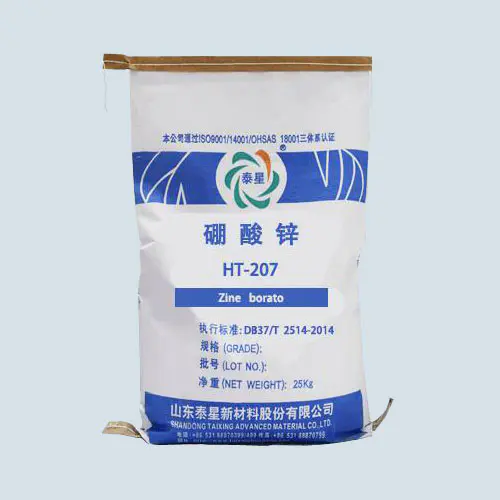
Zinc Borate


Ⅱ. Comparative analysis of chemical properties

1. Thermal stability and dehydration behavior: watershed of endothermic mechanism

This is the core performance difference between the two, which directly affects their flame retardant function and applicable temperature range.

Anhydrous zinc borate:

·No dehydration process: During the heating process (usually up to 800-900℃), there is no endothermic reaction caused by the removal of crystal water.

·Melting heat absorption: Its main heat absorption peak appears in the high temperature zone (about 900-1000℃), corresponding to the formation of zinc borate glass (melting heat absorption).

·Advantages: Maintain structural and quality stability at extremely high processing temperatures (>300℃), without defects such as bubbling or porosity caused by the release of water vapor.

Hydrated zinc borate:

·Multi stage dehydration and heat absorption: one of its core flame retardant functions. Taking 3.5 hydrate as an example, dehydration and heat absorption cover a wide temperature range of 100-350℃.

·100-150℃: Remove adsorbed water and some crystalline water (endothermic).

·200-300℃: Remove the main structural water (strong endothermic peak).

·Advantage: Provides strong endothermic cooling effect in the critical temperature range of polymer decomposition, effectively reducing the surface temperature of the material.

2. Surface characteristics and compatibility

Anhydrous zinc borate:

·Low surface polarity and relatively stronger hydrophobicity.

·In non-polar polymers such as polyolefin PP and PE, they usually have better dispersibility and compatibility, and have less impact on the mechanical properties of the material.

Hydrated zinc borate:

·There are hydroxyl groups (-OH) on the surface, which have strong polarity and good hydrophilicity.

·Dispersion is better in polar polymers (such as PVC, PA) or aqueous systems.


Ⅲ. Flame retardant mechanism and functional positioning

Flame retardant pathway of anhydrous zinc borate

1. Melting at high temperatures during a fire, forming a dense and insulating layer of borate glass on the surface of the material.

2. As a Lewis acid, it catalyzes dehydration, cross-linking and other reactions of polymers, forming a more stable and dense expanded char layer.

3. The formed glassy layer has good reflection and scattering effects on thermal radiation.

Flame retardant pathway of hydrated zinc borate

1. Through multi-stage dehydration reactions, a large amount of heat is absorbed from the combustion zone, reducing the substrate temperature.

2. Release water vapor to dilute the concentration of oxygen and combustible gases.

3. Reacts chemically with halogenated systems to enhance flame retardant efficiency.

4. The final dehydrated product is activated zinc borate, which also has the ability to promote carbonization and form a glass layer.

Functional positioning analogy:

·Anhydrous zinc borate is more like an "architectural master" who focuses on building sturdy insulation barriers.

·Hydrated zinc borate acts like a "firefighter", extinguishing the fire source by absorbing heat and diluting it in the first place.


Ⅳ. Common Misconceptions and Clarifications

Misconception: "The flame retardant effect of anhydrous zinc borate is not as good as that of hydrated zinc borate because it does not absorb heat

Clarification: The flame retardant mechanisms of the two are different. The anhydrous "glass forming" and "catalytic carbonization" effects often provide a more durable protective layer in high heat flux fires, making them "long-lasting defense" flame retardants.


Misconception: "Hydrated zinc borate will completely fail at high temperatures

Clarification: The chemical composition of the dehydrated product of hydrated zinc borate is similar to that of anhydrous zinc borate, and it also has the ability to promote carbonization and form a glass layer. It is a composite flame retardant with "early blocking+later defense".


Misconception: "Anhydrous products can be obtained by drying hydrated zinc borate at will

Clarification: Simple heating dehydration yields amorphous or structurally collapsed zinc borate, which has significant differences in dispersibility and catalytic activity compared to industrial anhydrous zinc borate with intact crystal structure, and its performance cannot be equated.


Conclusion

Anhydrous and hydrated zinc borate are two important flame retardant materials with complementary functional positioning, rather than a simple substitution relationship of advantages and disadvantages. 

Related News
Leave me a message
X
We use cookies to offer you a better browsing experience, analyze site traffic and personalize content. By using this site, you agree to our use of cookies. Privacy Policy
RejectAccept