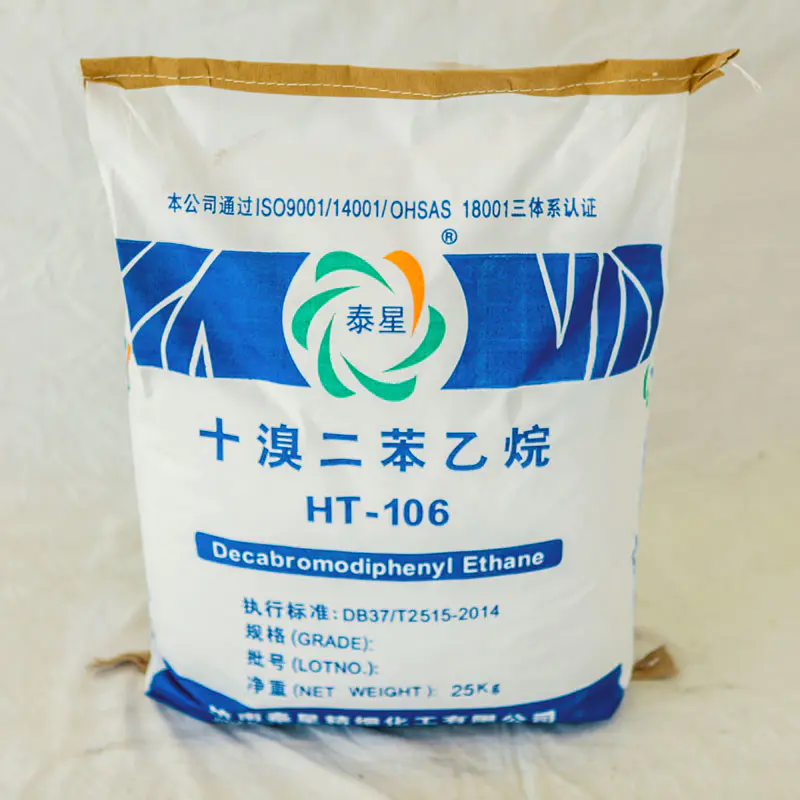
In the technical parameters of flame retardants, the "flame retardant rating" is not an inherent property of a single substance but rather the performance result of a composite material system formed by its interaction with specific polymer matrices and synergistic systems under standardized testing. For decabromodiphenyl ethane (DBDPE), one of the most widely used brominated flame retardants globally, the question of its "flame retardant rating" essentially explores "how to achieve the desired fire safety level with the optimal formulation in specific materials." This article will systematically analyze the scientific basis, key variables, and typical application data of DBDPE in achieving high flame retardant ratings.
The first and foremost principle to clarify is that decabromodiphenyl ethane itself does not possess a fixed "flame retardant rating." The final UL94 rating (e.g., V-0, V-2, 5VA) or oxygen index (LOI) it exhibits is the result of the synergistic effects of the following four factors:
1.The intrinsic combustion behavior of polymer matrices (e.g., polypropylene PP and high-impact polystyrene HIPS are distinctly different).
2. The dosage of DBDPE.
3. Whether and which "synergist" is used (the most critical one being antimony oxide, Sb₂O₃).
4. Other components in the overall formulation (such as fillers, toughening agents, and thermal stabilizers).
DBDPE is a highly effective gas-phase flame retardant, whose mechanism of action lies in: during polymer combustion, it decomposes upon heating to release bromine radicals (Br·), which can effectively capture the key radicals (H·, ·OH) that sustain the combustion chain reaction, thereby interrupting the combustion. However, achieving high flame retardancy levels (e.g., UL94 V-0) typically requires synergistic effects with co-adjutants to maximize its efficiency.
The high efficiency of DBDPE largely relies on the classical "bromine antimony synergistic effect".
·The role of DBDPE is to provide a rich and stable bromine source (with a bromine content of approximately 82%) that continuously releases active bromine species over a wide temperature range.
·The role of antimony trioxide (Sb₂O₃) is to act as an efficient synergist, reacting with hydrogen bromide (HBr) released by DBDPE to generate gaseous antimony bromide oxides (such as SbBr ∝). These substances can capture free radicals more efficiently in the gas phase, and their flame retardant efficiency is several times that of pure bromine based flame retardants.
·Synergy ratio: There is an optimal mass ratio range between DBDPE and Sb₂O₃, usually 3:1 to 2:1 (DBDPE: Sb₂O₃). At this ratio, the two can produce the best synergistic effect and achieve the target flame retardant level with the lowest total addition amount.
The following data is based on industry practice and the specific values need to be determined through experiments.
1. In high impact polystyrene (HIPS)
HIPS is the most classic and efficient application scenario of DBDPE.
·Target level: UL94 V-0 (1.6mm thickness)
·Typical formula range:
·DBDPE addition amount: 10-12 phr (weight parts per hundred parts of resin)
·Sb₂O₃ addition amount: 3-5 phr
·Total halogen antimony flame retardant addition amount: about 13-17 phr
·Performance characteristics: It is easy to achieve V-0, has a relatively small impact on the mechanical properties (impact strength) of the substrate, and has good processability. It is the mainstream flame retardant solution for TV and office appliance casings.
2. In polypropylene (PP)
PP has strong inertness, making it more challenging to achieve high flame retardant levels.
·Target level: UL94 V-2/V-0
·V-2 grade: It can be achieved using a higher amount of DBDPE alone (such as 18-22 phr), but there may be droplets present.
·V-0 level: The DBDPE/ Sb₂O₃ collaborative system must be used, and the total addition amount is relatively high.
·DBDPE addition amount: 18-25 phr
·Sb₂O₃ addition amount: 6-9 phr
·Total dosage: up to 24-34 phr
·Performance characteristics: High addition can significantly degrade the mechanical properties (especially impact toughness) and flowability of PP, often requiring the use of toughening agents and lubricants.
3. In ABS resin
ABS is more sensitive to flame retardants.
·Target level: UL94 V-0
·Typical formula range:
·DBDPE addition amount: 12-20 phr
·Sb₂O₃ addition amount: 4-7 phr
·Performance characteristics: The flame retardant efficiency is between HIPS and PP. Attention should be paid to the effect of flame retardants on the thermal deformation temperature and glossiness of ABS.
4. In wire and cable materials (such as PE, EVA)
Focusing on oxygen index (LOI) and vertical combustion testing.
·Goal: LOI>30%, pass VW-1 test.
·Typical formula: DBDPE is compounded with Sb₂O₃, zinc borate, clay, etc. to achieve a comprehensive balance of flame retardancy, smoke suppression, and anti dripping. The total amount added may be as high as 30-50 phr.
1. Dispersion uniformity: The ultimate uniform dispersion of DBDPE and Sb₂O₃ in the matrix is a prerequisite for achieving a stable high flame retardant level. Any agglomeration will lead to local flame retardant failure and performance weaknesses.
2. Thermal stability matching: The initial temperature of thermal decomposition of DBDPE is about 340 ℃, and it is necessary to ensure that it matches the processing temperature of the polymer (usually 220-300 ℃) to avoid premature decomposition during the processing.
3. Demand for anti drip agents: Some systems (such as PP) are prone to producing combustion droplets during combustion, which may result in failure to pass the V-0 test (although the flame may quickly self extinguish). Adding a small amount of polytetrafluoroethylene (PTFE) as an anti drip agent is a common solution.
4. Regulatory and environmental considerations: Although DBDPE is not listed in the POPs Convention, as a brominated flame retardant, it may be restricted by halogen-free regulations or customer requirements in some high-end markets or specific products (such as electronic products). Its complex system with Sb₂O₃ also faces pressure to reduce antimony.
Decabromodiphenyl ethane is a highly effective brominated flame retardant that can assist various polymers in achieving the highest UL94 V-0 flame retardant rating, but its successful application is not simply an "addition".
Its core value lies in:
·In HIPS and other systems, top-level flame retardancy can be achieved economically and efficiently with relatively low addition amounts.
·High thermal stability ensures a wide processing window.
The key to its application lies in system design:
·It must be scientifically compounded with synergists (Sb₂O₃) to find the optimal ratio.
·It must be considered as a part of the entire formulation system, in conjunction with the matrix resin, stabilizer, anti drip agent, etc.
·It must be verified through rigorous testing rather than relying on theoretical calculations.
Therefore, the most professional answer to the question "What is the flame retardant grade of decabromodiphenyl ethane?" is that it is a high-performance component that can serve as the core and construct a UL94 V-0 grade flame retardant material system. The final level of its implementation depends on how you scientifically apply it.Are you designing flame retardant formulations based on decabromodiphenyl ethane for specific polymers such as HIPS, PP, ABS, and seeking optimal addition ratios and synergistic solutions? We can provide a complete set of technical support from formula design, sample testing to performance optimization, helping you accurately achieve your target flame retardant level.