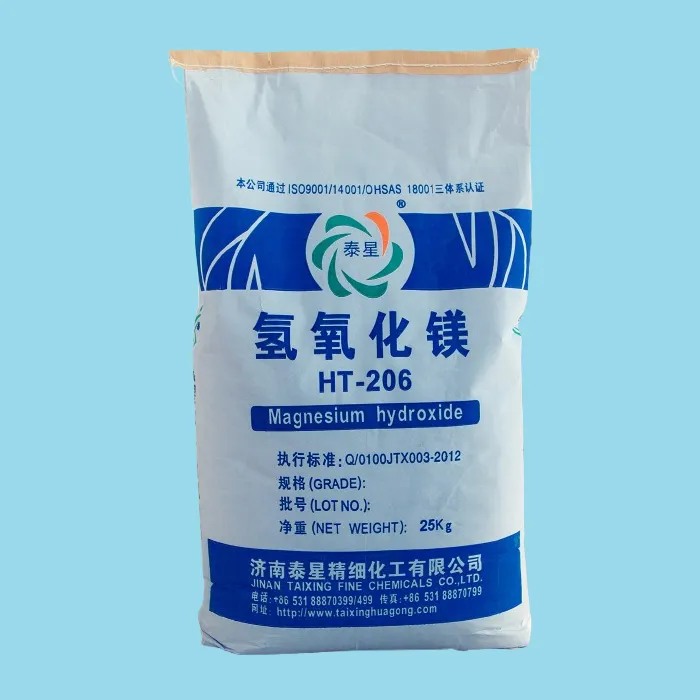
In the field of halogen-free flame-retardant cable materials, magnesium hydroxide (MDH) and aluminum hydroxide (ATH) are the two mainstream filling flame retardants, and their selection directly affects the flame retardant grade, processing performance, long-term reliability, and cost of the cable. This article is based on the thermal decomposition mechanism, crystal morphology, and surface characteristics. It systematically compares the core differences between the two in terms of decomposition temperature, flame retardant efficiency, mechanical effects, electrical insulation, and environmental resistance, as well as specific application scenarios. It provides a scientific selection decision-making framework and compound optimization strategies.
·Aluminum Hydroxide (ATH, Al(OH)₃):
·Decomposition temperature: Low, around 180-220 ℃, begins endothermic decomposition, with a peak at around 205 ℃.
·Heat absorption value: relatively high, about 1050 J/g.
·Reaction equation: 2Al(OH)₃ → Al₂O₃ + 3H₂O↑ (releasing approximately 34.6wt% of bound water).
·Impact: The significant effects of heat absorption, cooling, and release of water vapor dilution limit its application in high-temperature processing systems, such as peroxide crosslinking.
·Magnesium Hydroxide (MDH, Mg (OH) ₂):
·Decomposition temperature: relatively high, around 300-340 ℃, begins endothermic decomposition, with a peak at around 330 ℃.
·Heat absorption value: about 1300 J/g.
·Reaction formula: Mg(OH)₂ → MgO + H₂O↑ (releasing approximately 31.0 wt% of bound water).
·Impact: Higher thermal stability makes it suitable for cable material systems with higher processing temperatures.
·Crystal morphology: ATH is usually irregular plate-like or diamond shaped; MDH is mostly hexagonal plate-like crystals. MDH has higher crystal hardness and relatively greater wear on processing equipment.
·Surface energy: Both are hydrophilic and have poor compatibility with hydrophobic polymers. Surface modification (coating with stearic acid, silane, titanate, etc.) is necessary, and the modification effect is the key to determining the filling amount and final performance.
|
Performance dimension |
Aluminum hydroxide(ATH) |
Magnesium hydroxide(MDH) |
Inspiration for Cable Applications |
|
Processing adaptability |
Low decomposition temperature, only suitable for systems with processing temperature ≤ 200 ℃, such as silane crosslinking, irradiation crosslinking, or partially thermoplastic sheath materials. |
High thermal stability, suitable for systems with processing temperatures of 180-300 ℃, such as peroxide cross-linked polyethylene (XLPE) and high-temperature extruded sheaths. |
Primary selection criteria: Select based on the production process of the cable (temperature, shear force) in advance. |
|
Flame retardant efficiency |
High heat absorption value, excellent smoke suppression effect. But achieving the same flame retardant level (such as UL94 V-0) usually requires a higher filling amount (60-65%). |
The heat absorption per unit mass is higher, and the decomposition residue MgO is more stable at high temperatures, resulting in a better protective effect of the formed carbon layer. Usually, the filling amount is slightly lower than ATH (55-65% can achieve the same effect). |
MDH has slight advantages in anti dripping and suppressing post combustion, especially suitable for high flame retardant requirements (such as IEC 60332-3 Cat A). |
|
Influence on mechanical properties |
The hardness is low, and the stiffening effect on the polymer matrix is weak, but high filling still significantly damages toughness (with a decrease in fracture elongation). |
The high hardness of the crystal results in a more significant stiffening effect on the matrix, and the negative impact on impact strength and elongation at the same filling amount is usually greater than that of ATH. |
For applications that require high flexibility (such as drag chain cables and robot cables), high filling MDH should be used with caution, or compensated with elastic substrates or composite modifications. |
|
Electrical performance |
The decomposition product Al₂O₃ is an excellent insulator that helps maintain insulation resistance. But high filling may introduce impurity ions, affecting the volume resistivity. |
The decomposition product MgO also has good insulation and lower moisture absorption than Al₂O₃, which helps to maintain more stable dielectric properties in humid environments. |
Strictly test the electrical performance of medium and high voltage insulation materials after absorbing water. MDH typically exhibits better long-term electrical stability. |
|
Acid resistance and precipitation resistance |
The residue of Al₂O₃ is amphoteric and may react in acidic or strongly alkaline environments. Long term application in acidic soil should be considered. |
MgO residue is alkaline and has poor acid resistance, but it can neutralize acidic gases produced by combustion (such as HCl, SO₂), which is advantageous for places with low corrosive flue gas requirements. |
Evaluate the acidity, alkalinity, and humidity of the cable usage environment (chemical, tunnel, ocean) and select a more stable system. |
|
Smoke suppression property |
Excellent. ATH is widely recognized as one of the most efficient smoke suppressants, with a much lower smoke output than most flame retardants. |
Excellent, but with the same filling amount, the smoke suppression effect is usually slightly inferior to ATH. |
For places with strict requirements for smoke toxicity such as subways and high-rise buildings, ATH or ATH based formulations should be given priority consideration. |
|
Density |
about 2.42 g/cm³ |
about 2.38 g/cm³ |
The cable density of the formula cable is slightly lower, which is beneficial for reducing weight and unit length cost. |
-Low temperature processing cables: PVC, soft EVA, low smoke and halogen-free medium low temperature sheath, control cables
-General building wiring, home decoration cables, indoor weak current cables
-Cost sensitive, large quantities, flame retardant requirements V-1/V-2, flame retardant Class C/B
-Weak flame retardant scenarios with low filling, high elongation, and high flexibility
-High temperature processing system: PP, XLPE, irradiation crosslinking, silane crosslinking TPE/TPU
-High end security scenarios: subway, high-speed rail, ships, nuclear power, tunnels, hospitals, data centers
-New energy cables: photovoltaic, energy storage, wind power, charging piles, power battery harnesses
-High voltage/communication cables: require high insulation, low dielectric, low smoke, and low toxicity
-Long term weather/heat resistant cables: 105 ℃, 125 ℃, 150 ℃ grades
Recommended ratio: ATH: MDH=3:1~1:1
-Balancing processing window and cost
-Synergistic improvement of flame retardancy and smoke suppression
-Better mechanical and extrusion stability
-Can meet strict standards such as Class A flame retardant, Class B1, UL VW-1, IEC 60332, etc
There is no absolute "superiority or inferiority" between magnesium hydroxide and aluminum hydroxide in cable materials, only "adaptation" based on specific application scenarios. Selection is moving from empiricism to precise decision-making based on data and mechanisms.