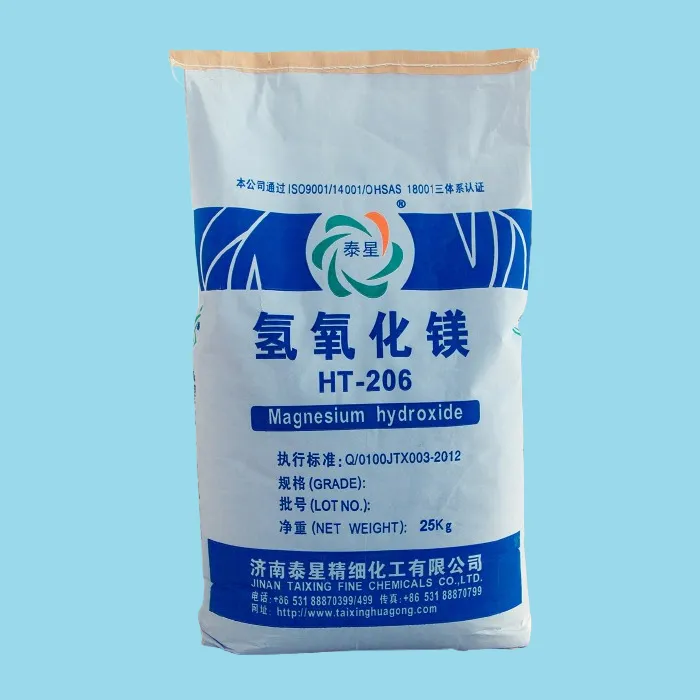
Magnesium hydroxide (Mg(OH)₂) is increasingly widely used as an environmentally friendly inorganic flame retardant in polymers such as polypropylene, polyethylene, and nylon. However, its dispersion uniformity in the plastic matrix directly affects the flame retardant efficiency, mechanical properties, and processing stability of the composite material. This article systematically explores professional solutions to enhance the dispersibility of magnesium hydroxide from the perspectives of interface compatibility, agglomeration mechanism, and processing kinetics.
Magnesium hydroxide particles have high surface polarity and strong hydrophilicity, but poor compatibility with hydrophobic polymers, and are prone to secondary agglomeration due to van der Waals forces. Aggregates not only become stress defect points, but also hinder the efficiency of flame retardant gas release, leading to a decrease in the oxygen index of the system. The essence of improving dispersion lies in reducing the interaction energy between particles, enhancing the interface bonding between particles and matrix, and utilizing processing shear force to achieve the disintegration and aggregation of aggregates.
Using amino silane (such as KH-550) or mercapto silane to treat magnesium hydroxide can form a hydrophobic layer on its surface. After hydrolysis of silane, Si-OH condenses with surface hydroxyl groups of Mg (OH) ₂ to form Si-O-Mg covalent bonds, significantly reducing surface energy. Research has shown that when the grafting rate exceeds 60%, the dispersion size of magnesium hydroxide in PP can be reduced from>10μm to 1-2μm.
Fatty acids such as stearic acid and oleic acid can undergo chemical adsorption with the surface of magnesium hydroxide through carboxyl groups, and long carbon chains provide steric hindrance. A more advanced method is to use titanium and aluminum ester coupling agents, whose molecular structure can combine with both inorganic and organic phases simultaneously, and form an organic monolayer on the surface of the particles to improve melt flowability.
By in-situ polymerization or grafting reaction, polymer chains similar or compatible with the matrix resin (such as polyacrylate, maleic anhydride grafted polyolefin) are introduced on the surface of magnesium hydroxide. This method can construct a "flexible interface layer" to alleviate interface stress caused by differences in thermal expansion coefficients.
Using a co rotating twin-screw extruder, a high-strength shear field is constructed by combining kneading blocks, toothed discs, and other components. Optimizing the screw configuration enables the material to undergo multiple cycles of compression shear redistribution. Adding a static mixer before the mold can further eliminate the unevenness of melt temperature and flow rate.
Add some magnesium hydroxide from the side feeding port to avoid mixing with the resin at once, which may result in insufficient shear energy. By using a grinding disc type ultrasonic extrusion device and utilizing the cavitation effect to break up aggregates, the size of the dispersed phase can be reduced by more than 30%.
Magnesium hydroxide begins to decompose above 340℃, so the processing temperature should be below this threshold but above the complete melting temperature of the resin. For the PP system, it is recommended to set the barrel temperature in sections of 180-200-190℃ (die head) to avoid excessive temperature causing surface modifier detachment.
Adding 0.2-0.8% polymer dispersant (such as polyethylene glycol polypropylene glycol block copolymer) can reduce melt viscosity and promote particle wetting. Hyperbranched polymers exhibit significant steric hindrance due to their spherical three-dimensional structure, preventing re aggregation.
Loading some magnesium hydroxide onto porous nano silica or carbon nanotubes to form a "core-shell" or "sea island" structure can change its stacking method and form a more uniform distribution network in the matrix.
When compounding with synergists such as zinc borate and layered silicates, attention should be paid to matching the density and particle size of each component. The mother particle pre dispersion process should be used to avoid phase separation caused by density differences.
·Dispersion quantification: SEM images combined with ImageJ software to calculate area weighted average particle size; TEM observation of interface layer thickness.
·Rheological characterization: In dynamic frequency scanning, the slope of the storage modulus (G ') in the low-frequency range can reflect the structure of the filler network; The appearance of a single semicircle in the Cole Cole plot indicates good dispersion.
·Performance correlation analysis: The Limiting Oxygen Index (LOI) is positively correlated with the fractal dimension of the tensile section; The burning temperature of the hot wire (GWT) is directly related to the uniformity of dispersion.
Improving the dispersibility of magnesium hydroxide in plastics is a systematic project that requires consideration of three dimensions: surface thermodynamic modification, processing rheology control, and formulation co design. The future trend is to develop reactive multifunctional additives to achieve simultaneous surface modification and dispersion during the processing. Through the above comprehensive strategies, the mechanical retention rate and flame retardant efficiency of magnesium hydroxide flame retardant plastics can be significantly improved, promoting the application of halogen-free flame retardant materials in high-performance fields.