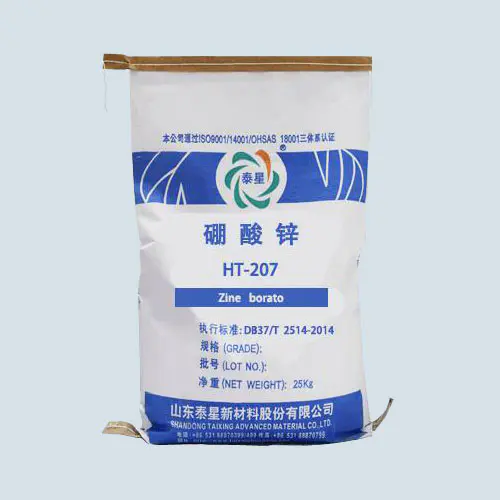
Summary: Zinc Borate has emerged as one of the most reliable and eco-friendly flame retardants for polymers and PVC. This article explores its chemical properties, benefits, industrial applications, and why it is preferred over other halogen-free flame retardants. With growing environmental regulations, Zinc Borate offers a perfect balance between performance and sustainability.
With the increasing demand for fire-safe materials in industries such as construction, electronics, automotive, and consumer products, the role of effective flame retardants has never been more critical. Zinc Borate is a versatile, halogen-free flame retardant that not only provides excellent fire protection but also contributes to environmental sustainability.
Zinc Borate is an inorganic compound typically represented as 2ZnO·3B2O3·3.5H2O. It exhibits several properties that make it ideal for polymer applications:
The advantages of using Zinc Borate in polymers and PVC are significant, contributing to both safety and material performance:
Zinc Borate is widely used across multiple industries due to its versatility:
Compared to traditional halogenated flame retardants, Zinc Borate offers several advantages:
Environmental regulations worldwide are pushing for halogen-free flame retardants in consumer and industrial applications. Zinc Borate aligns perfectly with these requirements:
Zinc Borate has proven to be one of the most effective eco-friendly flame retardants for polymers and PVC. Its unique combination of fire resistance, smoke suppression, chemical stability, and environmental safety makes it an ideal choice for modern industries seeking sustainable solutions. By integrating Zinc Borate into polymer formulations, manufacturers can meet safety standards while supporting environmental responsibility. Contact us.