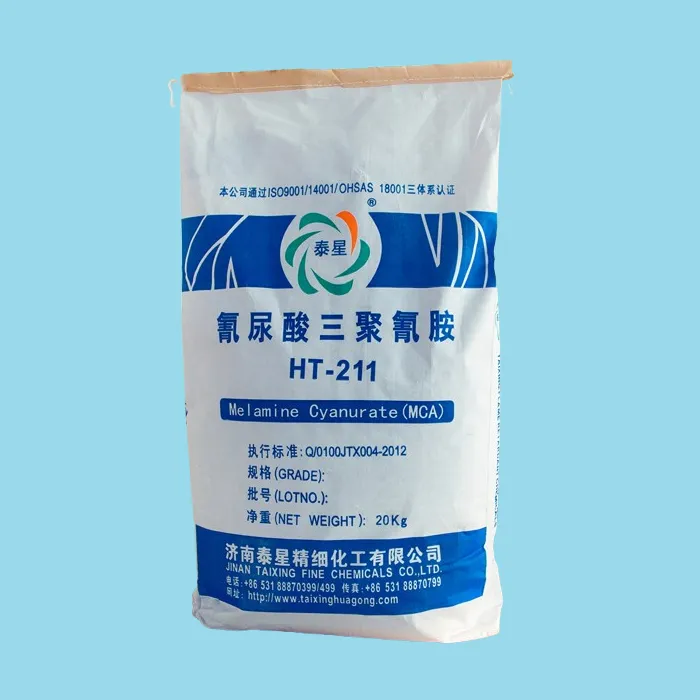
Nylon (PA6/PA66/PPA), as the core category of engineering plastics, has shifted its flame retardant scheme from traditional halogen based to nitrogen based, phosphorus based, phosphorus nitrogen synergistic and other environmentally friendly systems. Melamine cyanurate (MCA) and ammonium polyphosphate (APP) are currently the two most widely used and cost-effective mainstream choices for halogen-free flame retardancy in nylon. There are significant differences in the flame retardant mechanism, performance adaptation, processing characteristics, and applicable scenarios between the two, which directly determine the flame retardant level, mechanical retention, electrical insulation, weather and moisture resistance, cost, and global compliance of the end product.
MCA is a pure nitrogen based halogen-free flame retardant, mainly based on the synergistic effect of gas phase and molten droplets:
-Heat decomposition absorbs heat, releases non combustible gases such as NH3 and N ₂, dilutes combustible mixtures and cools them down;
-Promote the formation of droplets of nylon to dissipate heat and quickly escape from the combustion zone;
-Weakly carbonized, achieving V-0 flame retardancy through "heat transfer+dilution", suitable for thin-walled pure nylon.
APP is a phosphorus nitrogen based expansion flame retardant, mainly composed of condensed phase to form carbon:
-Pyrolysis generates polyphosphoric acid/pyrophosphate, which strongly dehydrates and catalyzes the formation of a dense continuous carbon layer in nylon;
-The carbon layer physically isolates the transmission of oxygen, heat, and combustibles;
-Gas source expansion foaming enhances insulation and oxygen barrier, resulting in higher flame retardant efficiency and stronger resistance to erosion.
Core difference: MCA relies on "heat dissipation", while APP relies on "flame sealing".
-MCA: Adding 8% -12% pure PA6/PA66 can achieve UL94 V-0 (1.6mm); The efficiency decreases after glass fiber reinforcement, and the tendency to melt droplets makes it impossible to pass through V-0.
-APP: Adding 10% -15% at the same thickness can achieve V-0; The glass fiber reinforced system can still stably form carbon, making it more suitable for reinforcing nylon.
-MCA: Has minimal impact on stretching, bending, and impact, retains excellent toughness, and does not significantly weaken fluidity.
-APP: High addition has a slight impact on toughness and strength; Microencapsulated apps can significantly improve compatibility and mechanical retention.
-MCA: High CTI (up to 600V), low precipitation, low corrosion, preferred for electronic connectors.
-APP: Ordinary APPs are prone to moisture absorption and hydrolysis, reducing insulation properties; The high aggregation degree/microcapsule APP can meet the requirements of medium and high voltage electrical.
-MCA: Thermal stability ≥ 300 ℃, suitable for PA6/PA66 conventional injection molding, no decomposition, no yellowing, no odor.
-APP: High aggregation APP with heat resistance ≥ 280 ℃; Ordinary apps have low temperature resistance, are prone to hydrolysis, precipitation, and corrosion of equipment.
-MCA: Low moisture absorption, not easy to precipitate, good weather resistance, suitable for long-term outdoor/humid and hot environments.
-APP: Ordinary APP is hydrophilic, easily hydrolyzed, and prone to powdering; Microcapsule modified APP can significantly improve hydrolysis resistance and precipitation resistance.
-MCA: halogen-free, low smoke, low toxicity, non corrosive, compliant with RoHS, REACH, UL, EN 45545, free of heavy metals and harmful halogens.
-APP: halogen-free compliance; Ordinary apps have risks of hydrolysis and precipitation, while high aggregation/microcapsule apps meet the low smoke and toxicity requirements for automobiles and rail transit.
-MCA: White powder, good compatibility, high gloss, easy coloring, and no whitening of the product.
-APP: Ordinary APPs are prone to surface fogging caused by precipitation; Microcapsule apps can improve appearance.
-MCA: excellent dispersion, non stick screw, non corrosive mold, non blocking mesh, suitable for high-speed injection molding and thin-walled parts.
-APP: Ordinary APPs are prone to foaming and hydrolysis due to moisture absorption, and have stronger equipment corrosiveness; Modified APP can achieve stable processing.
-Pure resin nylon (without fiberglass): PA6/PA66 cable ties, terminals, shells, thin-walled parts
-High CTI electronic and electrical: connectors, switches, sockets, coil frames
-Requirements for low smoke, low toxicity, high gloss, and high toughness
-Automotive interior, lightweight structural components, household appliance structural components
-Cost sensitive, large-scale, stable mass production
-Fiberglass reinforced nylon (10% -30% GF)
-Thick walled components, erosion resistance, droplet resistance, high flame retardant safety
-New energy, energy storage, rail transit, industrial high-voltage components
-Require vertical combustion without dripping and resistance to high temperature radiation
-Scenarios with no droplets, low smoke toxicity, and high reliability
Most high-end nylon uses a composite system of MCA+high polymerization APP+synergist:
-Reduce the total addition amount and improve mechanical retention
-Balancing droplet heat dissipation and carbonization insulation
-Realize V-0, low smoke, low toxicity, high CTI, and hydrolysis resistance
-Meet the highest global standards for automobiles, new energy, and rail transit
Pure nylon, thin-walled, electronic and electrical, low-cost, high gloss → preferred MCA
Fiberglass reinforcement, thick wall, high safety, erosion resistance, no melt droplets → Preferred high polymerization/microcapsule APP
High end universal, high-performance, full scene adaptation → MCA+APP phosphorus nitrogen synergistic system
There is no absolute 'better', only a better fit. Only by combining material formulation, reinforcement system, flame retardant rating, electrical requirements, environmental weather resistance, and cost budget can we achieve maximum global market competitiveness.
In the global competition of nylon halogen-free flame retardant, MCA and APP are not substitutes, but the core solution of complementary scenarios and collaborative upgrades. Accurately matching the substrate, working conditions, and compliance requirements, selecting a single or compound system, can simultaneously achieve the four major goals of safety, performance, cost, and environmental protection, supporting the smooth entry of products into global mainstream markets such as Europe, America, Southeast Asia, and the Middle East.