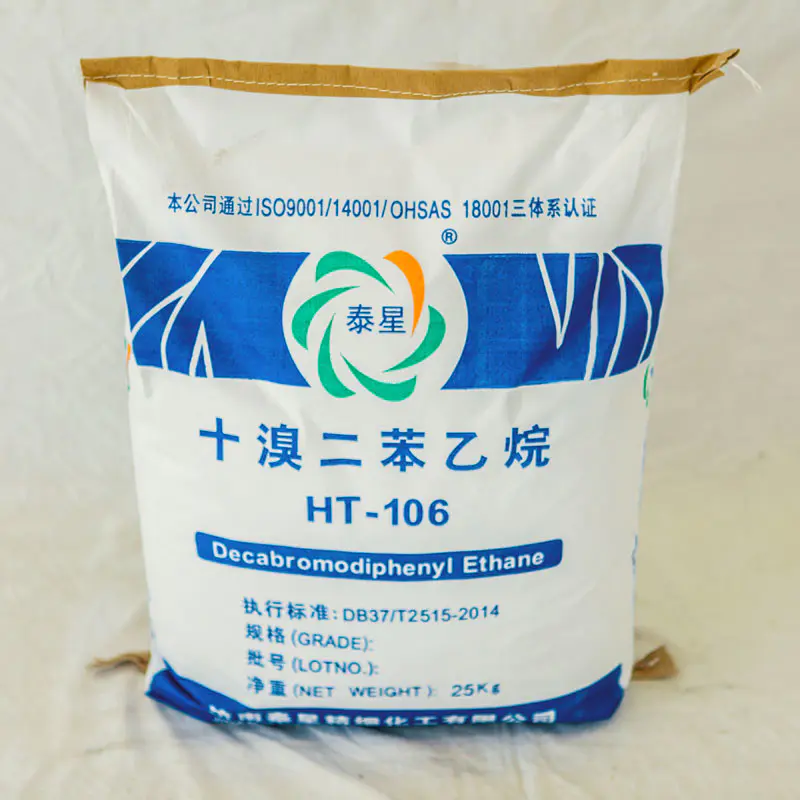
The "Blooming" phenomenon that occurs after long-term use of brominated flame retardants, especially aromatic high molecular weight varieties such as decabromodiphenyl ethane, in polymers is a typical mass transfer process driven by interfacial thermodynamic imbalance. It is not simply a "leakage", but the dynamic result of the dissolution diffusion recrystallization of flame retardant molecules in the solid polymer matrix, ultimately leading to the appearance of white frost, loss of luster, affecting spraying and bonding, and indicating potential degradation of flame retardant performance on the surface of the product. This article will start from the physical and chemical nature of migration and construct a systematic solution covering molecular design, formulation engineering, and process optimization.
To cure precipitation, it is necessary to first understand the fundamental cause of its occurrence, which lies in the contradiction between "dissolution" and "insolubility".
The stability of brominated flame retardants (taking DBDPE as an example) in polymer matrices depends on their solubility difference at processing temperature (molten state) and usage temperature (solid state).
·During high-temperature processing (>200 ℃): The viscosity of the polymer melt decreases, the free volume increases, and the kinetic energy of DBDPE molecules is high. Its apparent solubility in the matrix is high, which can achieve macroscopic uniform dispersion.
·Cooling solidification and long-term use (room temperature~80 ℃): Polymer chain segments move and freeze, the free volume decreases sharply, and the system transitions to a low-energy state. At this point, the equilibrium solubility of DBDPE in solid polymers is extremely low. Excess dissolved DBDPE molecules become "supersaturated solutes" with strong precipitation to reduce the driving force of Gibbs free energy in the system.
Key influencing factors:
·Polarity and solubility parameter (SP) mismatch: DBDPE is a non-polar molecule (SP~8-9 cal ¹/²/cm ³/²), with a large difference in SP value compared to polar polymers (such as some engineering plastics), resulting in poor compatibility and exacerbating precipitation tendency.
·Crystallinity and Molecular Migration Channels: The crystalline region of semi crystalline polymers (such as PP) is a barrier that flame retardants cannot penetrate, but its amorphous region provides migration channels. The higher the crystallinity and finer the grain size, the more tortuous the migration path, and the slower but more complex the precipitation path.
Unsaturated flame retardant molecules precipitate through the following steps:
1. Diffusion: Molecules in the amorphous region of polymers slowly diffuse towards the surface or interface (such as the contact surface with air or molds) through the "holes" provided by the movement of chain segments. The diffusion coefficient follows the Arrhenius formula, and an increase in temperature will exponentially accelerate this process.
2. Surface nucleation and growth: After the concentration of molecules diffusing to the surface reaches a critical value, they crystallize and nucleate under the drive of surface energy, gradually growing into visible crystals and forming a "frost spray".
Based on the above mechanism, the solution requires systematic intervention from two dimensions: reducing driving force and increasing migration resistance.
This is the most fundamental preventive strategy.
1. Choose high molecular weight/polymeric brominated flame retardants:
·Principle: Compared to small molecule flame retardants, polymeric (such as brominated polystyrene, brominated epoxy oligomers) or higher molecular weight varieties (DBDPE already belongs to this category) have weaker molecular chain mobility and a decrease in diffusion coefficient on the order of magnitude. Its entanglement with polymer chains is also stronger.
·Effect: It can greatly delay or even eliminate precipitation, but may require higher material flowability.
2. Surface microencapsulation modification:
·Principle: Coat the surface of brominated flame retardant particles with a polymer shell layer that is highly compatible with the matrix resin (such as polyolefin, melamine formaldehyde resin).
·Function: The shell serves as a physical barrier, directly blocking the contact and diffusion between the flame retardant core and the polymer matrix; Simultaneously improved particle dispersion. This is one of the most effective high-end technological paths to solve the precipitation problem.
1. Introducing synergists and fillers with strong interfacial interactions:
·Principle: Add nano or micro fillers with special surface treatment and high specific surface area, such as surface modified silica, organic montmorillonite, porous molecular sieves, etc.
·Function: These fillers have a large number of active sites on their surfaces, which can "capture" free bromine based flame retardant molecules through physical adsorption or weak chemical reactions, anchoring them in the filler polymer interface region, significantly reducing their effective diffusion concentration and migration rate.
2. Compound compatibilizer/polymer plasticizer:
·Principle: Add low molecular weight polymers (such as specific functionalized polyolefin elastomers) that have good compatibility with both the matrix resin and flame retardants.
·Function: The compatibilizer acts as a "bridge" in the system, improving the compatibility between the flame retardant and the matrix, reducing the interfacial energy, and thus thermodynamically reducing the driving force for precipitation.
1. Extreme dispersion process:
·Principle: By optimizing the twin-screw shear field and mixing distribution, the flame retardant is ensured to be uniformly distributed with native particle size or extremely small aggregates.
·Function: Uniform dispersion reduces local concentration gradients (one of the diffusion driving forces), and fine particles have a higher specific surface area, making them easier to be "wrapped" and fixed by polymer segments.
2. Quenching and heat treatment (annealing) process:
·Principle: For crystalline plastics, rapid cooling (quenching) after injection molding can form finer and more imperfect crystal structures, increase the entanglement density of amorphous regions, and thus increase migration resistance.
·Reverse thinking - controllable annealing: Annealing is carried out at a temperature lower than the significant diffusion of flame retardants, which promotes more complete polymer crystallization. Although it may slightly increase the size of the crystal region, it can more stably "lock" flame retardant molecules in the limited amorphous region between the perfect crystals. This method requires precise regulation through experiments.
1. Accelerated aging test:
·Place the product at an elevated temperature (such as 70 ° C, 85 ° C) for long-term thermal aging, accelerate the diffusion process using Arrhenius' law, and evaluate the long-term precipitation risk in a shorter period of time.
2. Surface analysis techniques:
·Using Fourier transform infrared spectroscopy (ATR-FTIR) and X-ray photoelectron spectroscopy (XPS) to perform elemental analysis on the surface of samples before and after aging, accurately quantifying the changes in surface bromine concentration, and achieving early and quantitative diagnosis of precipitation phenomena.
3. Thermal analysis prediction:
·By measuring the glass transition temperature (Tg) and low-temperature loss peak of the material through dynamic thermo mechanical analysis (DMA), the mobility of amorphous region segments can be evaluated, and the migration tendency can be indirectly predicted.
·In PP/PE, strategy one (selecting polymeric/high molecular weight products) and strategy two (introducing nano fillers for anchoring) are emphasized. The crystallization process must be optimized (Strategy Three).
·In HIPS/ABS, due to the amorphous matrix and continuous migration channels, it is necessary to focus on strategy one (surface coating) and strategy two (capacity expansion), and ensure ultimate initial dispersion.
·In engineering plastics such as PA and PBT, there is a significant difference in polarity, and thermodynamic compatibility is the primary contradiction. Bromine based flame retardants or specialized compatibilizers that have undergone surface functionalization modification (such as amino or epoxy groups) must be used to form strong interfacial interactions.
The precipitation problem of brominated flame retardants is essentially the macroscopic manifestation of small molecule additives seeking thermodynamic stability in high viscosity non-equilibrium polymer solids. The solution must go beyond simple empiricism of "adding more" or "mixing more evenly".
The systematic solution path requires us to:
1. At the molecular scale, chemical modification is used to enhance the intrinsic compatibility between flame retardants and the matrix.
2. Use fillers and interface engineering to construct physical anchoring points and diffusion barriers at the nanometer/micrometer scale.
3. At the macroscopic processing scale, the final condensed structure is controlled through precision technology to lock in flame retardants.
Ultimately, the requirement of "preventing precipitation" will be placed in the product design stage of flame retardants and the initial design stage of composite material formulations, achieving a fundamental transformation from a passive cycle of "problem occurrence solving" to an active innovation of "predicting problems designing problem free systems".
Is your bromine based flame retardant formula facing precipitation, frosting, or long-term reliability challenges? We can provide a complete solution, including customized microencapsulation of flame retardants, recommendation of specialized compatibilizers, and precipitation risk assessment based on thermal analysis and aging testing, to help you obtain long-lasting and stable high-performance products.