Shandong Taixing Advanced Material Co., Ltd.
News

Why Is Aluminum Hypophosphite a Highly Effective Flame Retardant?

2025-12-08 0 Leave me a message

In the development of halogen-free flame retardants, aluminium hypophosphite (AHP) has stood out for its exceptional flame-retardant efficiency, emerging as a high-performance solution for engineering plastics, high-temperature nylon, and specialty coatings. Its "high efficiency" is not accidental but stems from its unique molecular structure, multi-mode flame-retardant mechanism, and minimal impact on material properties. This article will delve into the scientific essence of aluminium hypophosphite as an efficient flame retardant from the perspectives of materials science and combustion chemistry.


I. Unique Molecular Structure: The Physical and Chemical Basis for High-Efficiency Flame Retardancy

The core advantage of aluminum hypophosphite (chemical formula: Al(H₂PO₂)₃) is primarily reflected in its molecular design:

1. High phosphorus content: The mass fraction of phosphorus exceeds 30%. In flame retardant science, phosphorus is widely recognized as a highly effective flame retardant element. A higher effective phosphorus content means that a given mass of flame retardant can provide more active flame retardant components, which is a prerequisite for achieving "low dosage and high flame retardancy.".

2. Aluminum-Phosphorus Synergistic Framework: The stable crystalline structure formed by aluminum ions (Al³⁺) and hypophosphite ions (H₂PO₂⁻) endows it with excellent thermal stability (the initial decomposition temperature typically exceeds 300°C). This enables it to withstand the high-temperature processing of most engineering plastics (such as PA6 and PBT), preventing premature decomposition failure.

3. Reactive Functional Groups: The hypophosphite group can undergo specific chemical reactions upon heating, serving as the source for a series of subsequent gas-phase and condensed-phase flame-retardant effects.


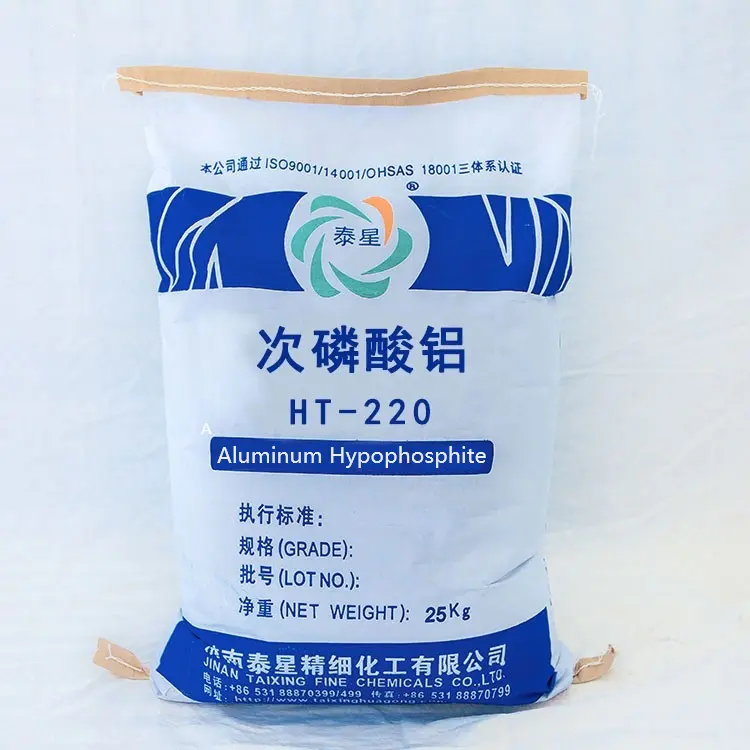
Aluminum Hypophosphite


II. Multi-mode Collaborative Flame Retardant Mechanism: Constructing a Three-Dimensional Fire Barrier

The high efficiency of aluminum hypophosphite comes from its synergistic attacks launched in different regions (gas phase, condensed phase) and stages (heating, decomposition, combustion) during the combustion process.

1. Condense camera mechanism: promote carbonization and build physical barriers

When the material is heated, aluminum hypophosphite can promote catalytic dehydration, crosslinking, and cyclization reactions of the polymer matrix, accelerating the formation of an expanded, dense, and high-strength carbon layer. This process is like coating the polymer with a layer of "ceramic armor".

·Function: This layer of carbon can effectively isolate heat transfer to the deep part of the substrate, block the escape of internal flammable volatiles, and prevent the infiltration of external oxygen, thereby cutting off the combustion cycle.

2. Gas phase mechanism: Capture free radicals and interrupt chain reactions

This is one of the most core efficient mechanisms of aluminum hypophosphite. During thermal decomposition, aluminum hypophosphite releases highly reactive phosphorus containing free radicals such as PO · and HPO ·.

·Function: These phosphorus containing free radicals will rapidly diffuse into the flame area and react with high-energy free radicals such as H · and · OH that maintain the combustion chain reaction, converting them into relatively inert substances. This process is like a "firefighting team" accurately capturing and neutralizing the burning "sparks", significantly reducing the energy and spread speed of the flames.

3. Dilution and cooling effects

Aluminum hypophosphite releases non combustible gases such as water vapor and phosphorus oxides during its decomposition process.

·Function: These gases can dilute the concentration of combustible gases in the flame zone and absorb a large amount of heat (the vaporization heat absorption effect of water is significant), physically cooling the combustion system.


III. Scientific Data Demonstrating Efficiency Advantages

Compared with traditional inorganic flame retardants such as aluminum hydroxide and magnesium hydroxide, the efficiency advantage of aluminum hypophosphite can be demonstrated through key data comparisons:

Characteristic dimension: Efficiency of aluminum hypophosphite (AHP) traditional inorganic hydroxides (such as ATH/MDH)

Effective element content, phosphorus content>30%, effective ingredient content, fixed unit mass, higher flame retardant activity.

Flame retardant efficiency (taking PA6 to achieve UL94 V-0 as an example) is usually added at a dosage of 15-25%, and usually requires 50-65%. A reduction of more than 50% in dosage can achieve the same top-level flame retardant level.

The impact on the mechanical properties of materials: Under low addition levels, high retention rates of strength and toughness are maintained, while high filling levels lead to a significant increase in viscosity and a significant decrease in toughness, resulting in a better overall performance balance.

The processing temperature adaptability is 300 ℃, suitable for engineering plastics to decompose at~200 ℃, limiting the application scope to a wider range.


IV. Beyond flame retardancy: endowing materials with added value

The true 'efficiency' lies not only in flame retardancy itself, but also in enhancing the overall value of the material. Aluminum hypophosphite also has:

·Excellent electrical insulation: The decomposition products do not affect the material's CTI (compared to the leakage trace index), making it suitable for electronic and electrical components.

·Good color stability: suitable for producing white or light colored products, without causing serious discoloration.

·Environmental friendliness: halogen-free, low toxicity, compliant with environmental regulations such as RoHS and REACH.


Conclusion

In summary, the efficient flame retardancy of aluminum hypophosphite is the result of systematic engineering: its high phosphorus content molecular structure lays the material foundation, and the dual synergistic mechanism of condensed phase carbonization and gas-phase free radical capture constructs a dynamic three-dimensional fire prevention network. The high-performance performance at low addition levels ultimately reflects its outstanding engineering application value. This makes it not only a flame retardant, but also a key technical element that helps high-end polymer materials achieve the best balance between safety, environmental protection, and performance.

For engineers seeking reliable halogen-free flame retardant solutions for materials such as polyamide (PA) and polyester (PBT/PET), understanding the scientific principles behind aluminum hypophosphite is the first step in making the best material selection.

Related News
Leave me a message
X
We use cookies to offer you a better browsing experience, analyze site traffic and personalize content. By using this site, you agree to our use of cookies. Privacy Policy
RejectAccept