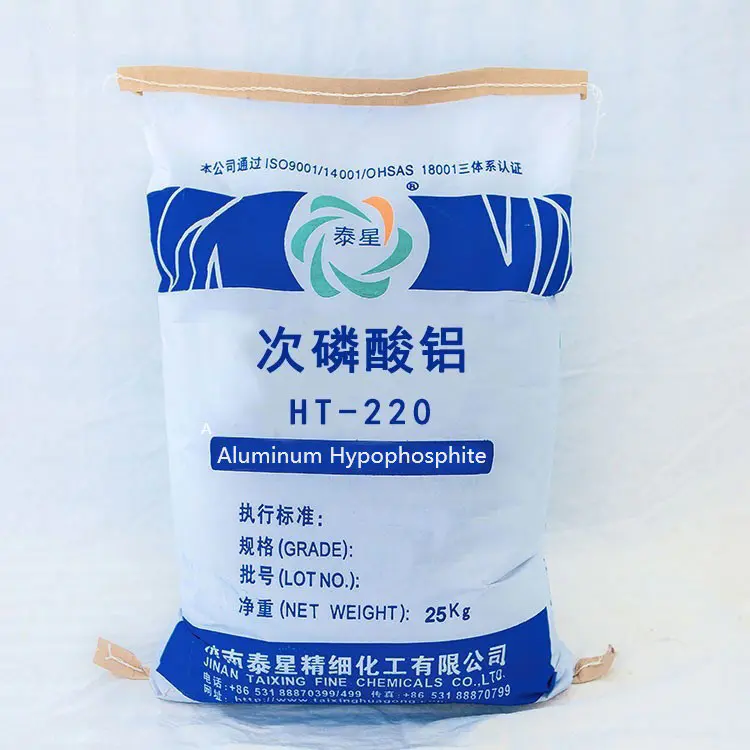
In polymer processing and applications, high-temperature environments serve as the ultimate test for material performance. For flame retardants, their behavior under high temperatures directly determines the effectiveness and durability of protection. Aluminum hypophosphite (AHP) is highly regarded in high-temperature engineering plastics precisely because it initiates a precise, synergistic, and efficient "active defense system" under extreme conditions. This article will delve into the core of its thermal decomposition, providing a comprehensive physical and chemical analysis of the process.
The vast majority of highly efficient flame retardants need to be 'activated' within a specific temperature window. The significant advantages of aluminum hypophosphite lie in its high thermal stability and precise temperature response. Its initial decomposition temperature is usually above 300 ° C (specifically between 300-350 ° C), which happens to be the critical safety range between the processing temperature (about 250-300 ° C) and the thermal decomposition ignition temperature (>400 ° C) of most engineering plastics (such as PA6, PA66, PBT).
This means:
1. Processing stability: Maintain chemical inertness during injection molding and extrusion processes, prevent premature decomposition, do not affect processing rheology, and do not produce bubbles or corrode equipment.
2. Accurate response: When the material is exposed to a fire source or abnormally overheated, AHP can quickly initiate its flame retardant program, and a protective barrier has been constructed when the polymer matrix begins to decompose in large quantities and produce flammable gases.
The role of aluminum hypophosphite at high temperatures is not a single reaction, but a continuous process involving multiple steps and products, which can be clearly revealed through thermogravimetric analysis (TGA) and gas evolution analysis (EGA).
Phase 1: Heat absorption decomposition and generation of flame retardant precursors (~300 ° C-450 ° C)
When the temperature exceeds 300 ° C, the crystal structure of aluminum hypophosphite begins to decompose, which is a strong endothermic process that can directly cool the polymer matrix.
Al (H ₂ PO ₂) ∝ → Al (PO ∝) ∝+3H ₂ ↑+Heat absorption
The core products of this stage are:
·Aluminum metaphosphate [Al (PO ∝) ∝]: a viscous glassy precursor with extremely strong reactivity.
·Hydrogen (H ₂): A non combustible gas that can dilute the concentration of oxygen and combustible gases in the flame zone.
Phase 2: Construction of Condensed Phase Barrier - Formation of Glass Ceramic Layer (450 ° C-600 ° C)
This is the key to achieving 'barrier protection'. The generated aluminum metaphosphate (Al (PO ∝) ∝) further reacts at high temperature and interacts with the carbon source generated by polymer decomposition:
1. Catalytic carbonization: Aluminum metaphosphate is a strong Lewis acid that can catalyze dehydration, crosslinking, and aromatization reactions of polymer molecules (especially oxygen-containing polyesters and polyamides), significantly increasing the amount of residual carbon and the degree of graphitization of the carbon layer.
2. Formation of expansion protective layer: Aluminum metaphosphate can react with released volatile products (such as water vapor) and expand to form a porous but dense composite ceramic/glassy barrier layer containing aluminum phosphorus oxygen carbon covering the material surface. This layer has extremely high thermal stability and can effectively block heat flow and mass transfer.
Stage 3: Quenching of gas-phase free radicals - Chemical interruption of combustion chain (penetrating the high-temperature combustion zone)
This is the chemical core of AHP for efficient flame retardancy. During the above decomposition process, phosphorus containing free radicals such as PO · and HPO · will continue to be released. These free radicals diffuse into the flame zone (gas phase) and undergo the following reactions with H · and · OH free radicals that maintain the combustion chain reaction:
PO· + H· → HPO
HPO + H· → H₂ + PO·
PO· + ·OH → HPO₂
These reactions convert high-energy H · and · OH radicals into more stable products, sharply reducing the heat release rate of flame reactions, thereby chemically suppressing or even extinguishing flames.
The high temperature efficiency of aluminum hypophosphite is due to the spatiotemporal synergy of the above mechanism:
1. Time synergy: Heat absorption and cooling (stage one) to buy time for carbonization (stage two); At the same time as constructing a physical barrier through carbonization, gas-phase free radicals are quenched (stage three) to directly attack the flame.
2. Space collaboration: constructing a carbon/ceramic layer with thermal insulation in the condensed phase (inside and on the surface of the material); Quenching free radicals in the gas phase (flame zone) to achieve full path blockade from the "fuel source" to the "flame".
This synergistic effect makes its flame retardant efficiency at high temperatures much higher than that of single mechanism flame retardants. For example, in polyamide (PA), an AHP addition of 15-25% can pass the UL94 V-0 test and maintain excellent flame retardant properties even after high-temperature aging (such as long-term thermal aging at 150 ° C), demonstrating its long-term effectiveness in high-temperature action.
In summary, aluminum hypophosphite does not undergo passive decomposition at high temperatures, but rather executes a precise activated multidimensional active protection program: it ensures processing safety with high thermal stability, responds to initial overheating through endothermic decomposition, and then constructs a condensed phase physical barrier through catalytic carbonization, while simultaneously releasing free radical quenchers to extinguish gas-phase flames. This triple synergistic mechanism, which combines physical cooling, physical barriers, and chemical inhibition, makes it a reliable and efficient solution for addressing high-temperature challenges.
For R&D personnel dedicated to developing high temperature resistant, high reliability halogen-free flame retardant materials (such as engineering plastics for electronic and electrical components, and new energy vehicle components), understanding the action spectrum of aluminum hypophosphite at high temperatures is the scientific basis for precise formulation design and performance optimization.
Do you need to evaluate the high-temperature flame retardant performance of aluminum hypophosphite based on your specific polymer system, such as high-temperature nylon PA6T/PA9T, PBT, PET, etc? We can provide targeted data and solutions based on real thermal analysis and combustion testing.