Shandong Taixing Advanced Material Co., Ltd.
News

Does Zinc Borate Affect the Transparency and Color of Plastics?

2026-01-28 0 Leave me a message

When pursuing high-performance and aesthetically pleasing flame-retardant plastics, a core engineering trade-off involves whether the introduction of functional fillers compromises the optical properties of the product. For zinc borate (ZB), a highly effective smoke-suppressing synergist, the question of whether it affects plastic transparency and color is not simply "yes" or "no," but a systematically controllable issue determined by "particle optical behavior," "interfacial interactions," and "polymer matrix nature." This paper will delve into its underlying mechanisms and provide a scientifically grounded design strategy.


I. Core Impact Mechanism: Light Scattering and Interface Effects

The impact of zinc borate on transparency essentially stems from the optical mismatch between inorganic particles and the organic polymer matrix, primarily manifested through two light scattering mechanisms.

1. Mie scattering: the primary cause of transparency loss and "whitening"

· Trigger condition: When the particle size (d) and the wavelength of incident light (λ, visible light ranges from 380-780 nm) are of the same order of magnitude (d ≈ 0.1λ - 10λ), i.e., when the particle size is between approximately 40 nm and 10 μm, strong Mie scattering occurs.

The typical state of zinc borate: The average particle size (D50) of conventional industrial-grade zinc borate usually falls within the range of 1-5 μm, precisely within the strong Mie scattering zone. When a large number of such particles are dispersed in a transparent matrix (such as PC, PMMA, or transparent PVC), they scatter light in all directions, leading to a sharp decline in light transmittance, an increase in haze, and an appearance of "milky white" or "chalky" translucency.


2.Interface scattering due to refractive index mismatch

Principle: When light passes through the interface of two media with different refractive indices, Fresnel reflection and refraction occur. The reflected light becomes scattered light.

· Data Comparison:

 · Refractive indices (n_D^20) of common transparent plastics: PC ~1.58, PMMA ~1.49, transparent PVC ~1.52-1.55.

 The refractive index of zinc borate (2ZnO·3B₂O₃·3.5H₂O) is approximately 1.48-1.52.

· Analysis: The refractive index difference between zinc borate and some plastics (e.g., PMMA) is relatively small (<0.03), resulting in theoretically weaker interfacial scattering; however, with materials like PC, where the difference is larger (>0.05), scattering becomes more pronounced. In practical composite systems, however, the more significant impact comes from macroscopic interfaces and defects caused by agglomerates.


3. Influence on color: physical "dilution" and chemical "interference"

·Physical dilution effect: Zinc borate itself is a white powder, and its addition to colored masterbatch or dyeing resin can cause physical dilution and light scattering, which may lead to a decrease in color saturation (brightness) and an increase in brightness (L value), making the color appear "white" or "lighter".

·Chemical interaction risk: During high-temperature processing (especially above 250 ℃), if zinc borate contains certain impurities (such as iron ions) or reacts with specific pigments or polymer decomposition products, it may cause unpredictable yellowing or color shift. But this is not an intrinsic characteristic of zinc borate, but depends on its purity and system compatibility.


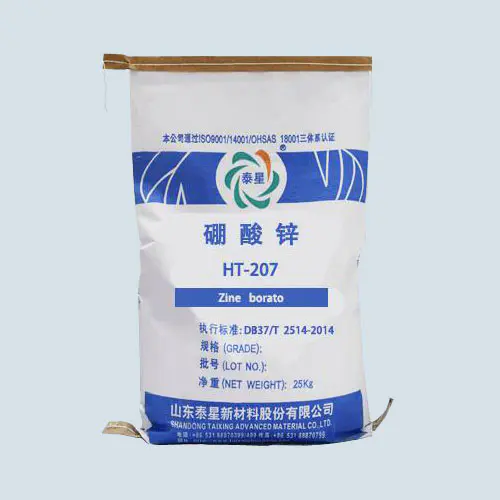
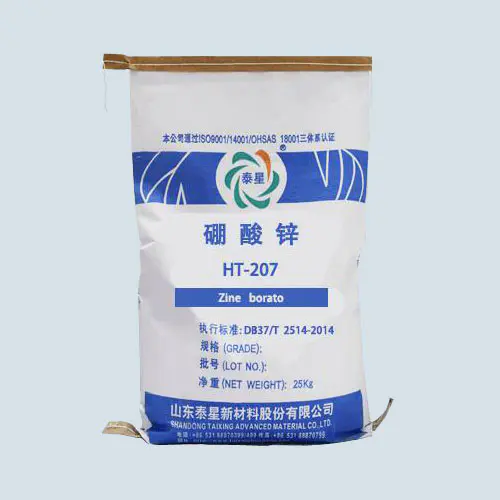
Zinc Borate


II. Scenario based Impact Assessment and Data Trends

The optical effects of zinc borate strongly depend on the final application system.

Scenario 1: In opaque or dark colored products (such as most flame-retardant engineering plastics, wire and cable materials)

·Impact assessment: Almost negligible.

·Reason: The product itself is opaque and has a dark color. The addition of zinc borate mainly affects internal light scattering, but does not affect surface color. Its core value - the synergistic effect of smoke suppression and flame retardancy - is fully utilized without sacrificing optical performance. This is the main application scenario of zinc borate.

Scenario 2: In semi transparent or natural colored products (such as certain electronic casings and electrical components)

·Impact assessment: It will lead to a significant increase in haze and a decrease in transmittance, causing the semi transparent material to approach white opacity.

·Countermeasure: It is necessary to optimize through the technical means described below, or accept this aesthetic change in exchange for fire safety performance.

Scenario 3: In products that require high transparency (such as optical components, transparent lampshades, high gloss surfaces)

·Impact assessment: The use of conventional zinc borate is usually not feasible and will completely destroy transparency.

·Scientific Challenge: This is a challenge to the limits of material design that requires the adoption of cutting-edge technological paths.


III. Systematic Solution: How to Minimize Optical Effects?

For applications that require a balance between flame retardancy and optical performance, precise control of the impact of zinc borate can be achieved through the following technical pathways.

Strategy 1: Extreme optimization of particle size - avoiding the core area of Mie scattering

·Objective: To reduce the primary particle size of zinc borate to well below 100 nm (entering the Rayleigh scattering region, the scattering intensity is proportional to the sixth power of the particle size, therefore the nanomaterialization effect is significant).

·Technology: Using nano synthesis technology to produce nano zinc borate or efficiently grade ultrafine powders.

·Limitations: Nanoparticles have extremely high surface energy and are prone to aggregation. Once aggregates of several hundred nanometers are formed, it will trigger severe Mie scattering again. Therefore, it must be used in conjunction with strategy two.


Strategy 2: Surface Modification Engineering - Achieving Refractive Index Matching and Dispersion Stability

This is the most effective and practical core technology.

1. Coupling agent treatment:

·Surface treatment of zinc borate using silane coupling agents (such as amino, epoxy silane) or titanium ester coupling agents.

·Dual function: Firstly, improve compatibility with polymers and reduce interface defects; Secondly, some coupling agents can form a refractive index transition layer on the surface of particles, reducing light scattering.

2. Polymer graft coating (recommended for high-end applications):

·Chemical grafting or physical coating of a transparent polymer shell on the surface of zinc borate particles that highly matches the refractive index of the matrix resin.

·Ideal material: For example, when used for PMMA, it can graft PMMA shell layer; When used for epoxy resin, it can be coated with epoxy compatible resin. This is equivalent to putting an "optical invisibility cloak" on the particles.

3. Microencapsulation:

·Encapsulate zinc borate in highly transparent microcapsules such as melamine formaldehyde resin (MF). The refractive index of MF resin (~1.55-1.60) is close to that of many engineering plastics, enabling excellent optical matching.


Strategy 3: Collaborative optimization of formula and process

1. Extreme dispersion process: A combination of high shear twin-screw extrusion and three roll grinding is used to ensure that particles are uniformly dispersed in their original state, eliminating macroscopic aggregates (the largest optical defects).

2. Precise control of addition amount: Under the premise of meeting the requirements of flame retardancy and smoke suppression, pursuing the lowest effective addition amount through formula optimization (such as compounding with other synergists) is the most direct method to reduce optical effects.


IV. Quantitative Impact and Design Decision Framework

Application requirements Recommended technical path Expected optical effect Potential impact on flame retardancy/smoke suppression performance
high transparency Nano scale surface grafting/coating of zinc borate+ultimate dispersion Can maintain high transmittance (>80%) and slight haze High unit quality efficiency, but high cost
Half transparency/good appearance Microencapsulation or fine surface modification of zinc borate Presenting a uniform semi transparent or milky white color, with a uniform color Excellent performance, making it a cost-effective choice
Opaque, but requires color stability Conventional or standardized modified zinc borate Not affecting the surface color, avoiding the risk of yellowing Mainstream choice, reliable performance
Extremely cost sensitive, optics not critical Ordinary industrial grade zinc borate Causing whitening and whitening of color Basic performance meets standards, with the best economy


Conclusion: Paradigm upgrade from "inevitable influence" to "controllable design"

In summary, zinc borate does indeed affect the transparency and color of plastics, but its degree and manner of influence are not uncontrollable inherent defects of the material, but design variables that can be systematically managed and optimized through modern materials science and process engineering.

·For the vast majority of industrial applications (opaque products), their optical effects can be ignored, and efforts should be focused on leveraging their excellent smoke suppression and synergistic flame retardant value.

·The essence of the challenge for applications with optical requirements is to control light scattering. By implementing a three in one system strategy of "nanomaterialization to reduce scattering sources", "surface engineering to achieve optical matching", and "extreme dispersion to eliminate defects", negative impacts can be reduced to an acceptable range, and even the next generation of special composite materials with high transparency and flame retardancy can be developed.

Therefore, for material engineers, when faced with customer inquiries about whether zinc borate will affect transparency, the professional answer is: "It depends on your specific performance matrix requirements. We have a systematic technical solution that can find and achieve the optimal balance point within your expected flame retardant level, optical indicators, and cost range." This marks an advanced concept from passively accepting additive side effects to actively designing the overall performance of materials.Are you developing a plastic product that meets both specific flame retardant standards and aesthetic requirements (such as color and transparency)? We can provide a complete solution from optical compatible zinc borate samples (nanomaterialization, surface modification), formulation integration technology support, to synergistic testing of optical and flame retardant properties, to help you accurately achieve product design goals.


Related News
Leave me a message
X
We use cookies to offer you a better browsing experience, analyze site traffic and personalize content. By using this site, you agree to our use of cookies. Privacy Policy
RejectAccept