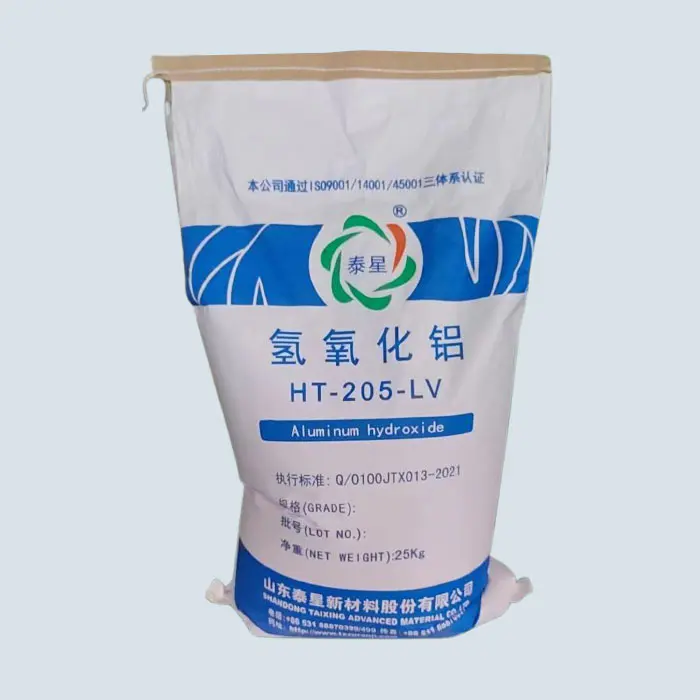
Aluminum hydroxide (ATH) is the most widely used environmentally friendly flame retardant filler in polymer materials, and its processing performance directly affects the preparation efficiency and final performance of composite materials. This article systematically analyzes the differences between ordinary ATH and low viscosity ATH in surface properties, rheological behavior, dispersion mechanism, and processing adaptability from the perspective of materials science, providing theoretical basis for selection in industrial applications.
Ordinary ATH is usually produced using the Bayer process, with a wide particle size distribution (1-25μm), high surface energy (about 70-100mJ/m²), and obvious polarity characteristics. Its crystal structure is mainly composed of α-Al(OH)₃, and the surface hydroxyl density can reach 4-8 OH/nm². These active sites are prone to form hydrogen bonding networks, leading to enhanced intermolecular interactions.
Low viscosity ATH is prepared through surface modification or special crystallization processes, and the surface energy can be reduced to 30-50 mJ/m². Key technologies include:
·Organic silane/fatty acid surface coating (coverage rate can reach over 85%)
·Crystal growth control to form a more regular shape
·Partial esterification of surface hydroxyl groups (modification rate usually>60%)
At high shear rates (1000 s ⁻¹), the melt viscosity of low viscosity ATH filling system (60% filling amount) can be reduced by 40-60% compared to ordinary ATH. This difference stems from:
·The friction coefficient between particles decreases (from 0.35 to 0.15-0.20)
·Combining differences in water content (low viscosity ATH typically<0.2%)
The ordinary ATH suspension system exhibits significant yield stress (usually>50 Pa), while the modified low viscosity ATH can reduce the yield stress to below 10 Pa, which significantly improves the flow initiation performance in the early processing stage.
The dispersion of ordinary ATH in polymer melt follows the agglomeration fragmentation dissociation model, requiring high shear stress (>10⁵Pa) to achieve effective dispersion. Experiments have shown that the energy required for complete dispersion is 2-3 times higher than that of low viscosity ATH.
Low viscosity ATH reduces surface energy, shortens infiltration time by 60-70%, and the dispersion process is more in line with the interfacial slip mechanism. Under the same shear conditions, the time required to achieve the same dispersion level is reduced by more than 40%.
During the twin-screw extrusion process, the low viscosity ATH filling system exhibits:
·Head pressure reduced by 25-35%
·Reduce torque by 20-30%
·The maximum filling amount can be increased by 15-20 percentage points
Low viscosity ATH has significant advantages in the rapid filling stage:
·Increase flow length by 30-50%
·Increase weld line strength by 20-25%
·Reduced anisotropy of the product (shrinkage rate difference decreased from 1.2% to 0.4%)
In solvent based systems, low viscosity ATH can prepare slurries with higher solid content (up to 75-80%) while maintaining appropriate construction viscosity.
It should be noted that optimizing processing performance may lead to other performance changes:
Flame retardant performance: Low viscosity ATH may delay the onset temperature of ATH decomposition due to the presence of surface coating (usually increased by 10-20 ℃), but the impact can be minimized by optimizing the coating rate (recommended to be controlled at 5-8%).
Mechanical properties: The moderate decrease in interfacial bonding strength can be compensated for by the combination of coupling agents. Studies have shown that the use of mixed coupling agents (silane+titanate) can restore the tensile strength to over 95% of that of ordinary ATH systems.
Low viscosity ATH has achieved significant improvement in processing performance through surface engineering, especially in reducing viscosity and improving dispersion efficiency at high shear rates. The selection of ATH should be systematically evaluated based on specific processing conditions, filling requirements, and final performance requirements. For application scenarios that pursue efficient processing and high filling, the technical advantages of low viscosity ATH are obvious; In conventional applications, ordinary ATH still has cost-effectiveness advantages. Future research should focus on multifunctional surface design to achieve a better balance between processing performance and final performance.